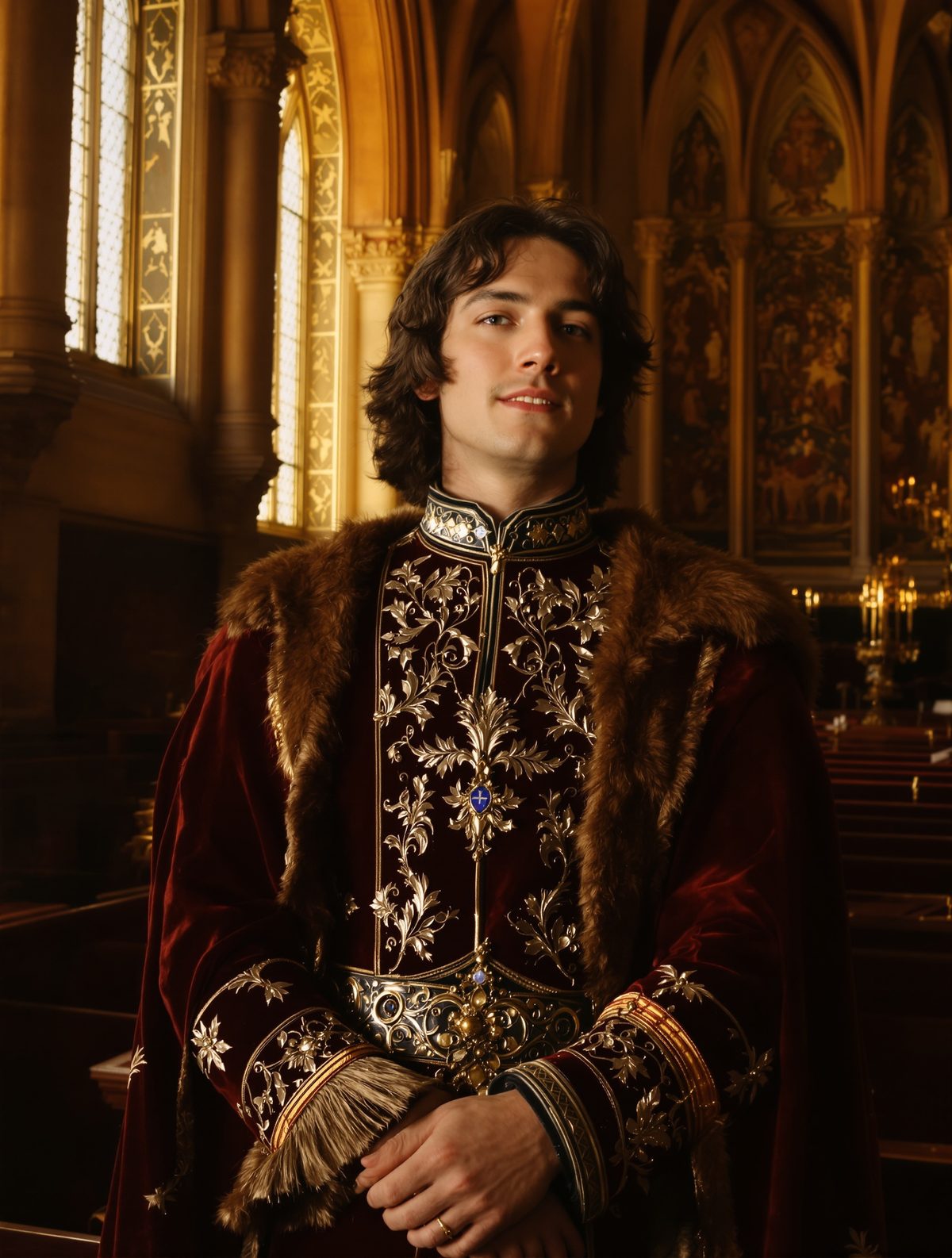
Picture this: you're sitting in a grand council chamber in 1464, surrounded by the most powerful nobles in England. The young King Edward IV has just announced he'll marry a foreign princess to secure vital alliances. The council breathes a collective sigh of relief. Then the king stands, walks calmly to the chamber door, and opens it to reveal a woman waiting outside. "Gentlemen," he says, "may I present my wife of five months." The woman who steps forward isn't a princess at all—she's Elizabeth Woodville, a commoner's widow with two young sons. In that single, electrifying moment, Edward IV shattered every convention of royal marriage and set in motion events that would reshape the English crown forever.
The Secret Wedding That Defied a Kingdom
On a spring morning in 1464, something extraordinary happened in a small chapel near Grafton, Northamptonshire. King Edward IV of England, just twenty-two years old and barely three years into his reign, secretly married Elizabeth Woodville in what historians describe as one of the most shocking royal weddings in British history. The ceremony was conducted by a single priest, with only Elizabeth's mother and two gentlewomen as witnesses. No fanfare, no foreign dignitaries, no political treaties—just a young king following his heart in the most spectacular fashion imaginable.
Elizabeth Woodville was beautiful, intelligent, and utterly unsuitable by the standards of medieval royal marriage. She was a widow with two young sons, her father was merely a knight, and her previous husband had fought against Edward in the recent civil wars. Royal marriages were diplomatic tools, designed to forge alliances and secure kingdoms. Love matches were luxuries that kings simply couldn't afford. Or so everyone thought, until Edward IV rewrote the rules entirely.
The story of how they met reads like something from a romance novel. Legend tells us that Elizabeth positioned herself under an oak tree near her family's estate, waiting to petition the king as he passed by. Some accounts suggest she held her two young sons by the hand, appealing for their inheritance rights. Whether this romantic tale is entirely accurate matters less than its enduring power—here was a king who saw a beautiful woman in distress and chose love over duty.
The Council Chamber Revelation
For five months, Edward managed to keep his marriage secret while his council grew increasingly insistent about his need to wed. The Earl of Warwick, Edward's most powerful ally and the man who had helped place him on the throne, was actively negotiating a marriage alliance with France. The proposed bride was Bona of Savoy, sister-in-law to the French king—a match that would have secured England's position in European politics and cemented Warwick's own influence.
The tension in that September council meeting must have been palpable. Here were England's most powerful nobles, having spent months crafting delicate diplomatic negotiations, presenting their king with what they saw as the perfect royal bride. They had every reason to expect gratitude and approval. Instead, they received the shock of their lives.
When Edward announced he was already married and summoned Elizabeth into the room, the political earthquake was immediate. These weren't just personal revelations—they were declarations of independence from the very nobles who had elevated Edward to the throne. The Earl of Warwick, in particular, was left humiliated before the French court, his carefully constructed negotiations reduced to nothing overnight.
A Queen from Nowhere
Elizabeth Woodville's transformation from knight's daughter to Queen of England was nothing short of miraculous. Born around 1437, she was the eldest daughter of Sir Richard Woodville and Jacquetta of Luxembourg. While her mother brought some noble blood to the family through her connections to European royalty, Elizabeth's upbringing was modest by royal standards. Her first marriage to Sir John Grey had been conventional for someone of her station—a solid alliance between minor noble families.
When Sir John died fighting for the Lancastrian cause at the Second Battle of St. Albans in 1461, Elizabeth found herself a widow at just twenty-four, struggling to secure her young sons' inheritance in a world where property rights were often decided by political allegiance rather than law. It was this very struggle that may have led to her fateful meeting with the king.
What made Elizabeth truly remarkable wasn't just her beauty, though contemporary accounts suggest she was genuinely stunning. She possessed an intelligence and dignity that would serve her well through the extraordinary challenges ahead. Within months of that council chamber revelation, she was crowned Queen of England in Westminster Abbey, transforming from petitioner to sovereign in a fairy-tale trajectory that captivated the nation.
The Ripple Effects of Royal Romance
Edward's secret marriage sent shockwaves through the delicate political landscape of 15th-century England. The Earl of Warwick, feeling betrayed and diminished, would eventually switch sides entirely, temporarily deposing Edward and restoring the Lancastrian Henry VI to the throne. This dramatic turn of events, directly traceable to that midnight wedding, plunged England back into the chaos of the Wars of the Roses.
The elevation of the Woodville family created its own controversies. Elizabeth's numerous siblings suddenly found themselves in line for prestigious marriages and powerful positions, leading to accusations of favoritism and the rise of a "new nobility" that threatened established hierarchies. The speed with which the Woodvilles ascended to prominence created lasting resentments among the traditional aristocracy.
Yet the marriage also produced something precious: a genuine royal love story and a partnership that would endure through extraordinary trials. Edward and Elizabeth had ten children together, including the future Edward V and Elizabeth of York, who would later become the mother of Henry VIII. Their union, born of passion and maintained through genuine affection, stood in stark contrast to the purely political marriages that dominated royal history.
Legacy of a Love Match
The consequences of Edward IV's secret wedding extended far beyond his own reign. When Edward died suddenly in 1483, the questionable legitimacy of his marriage became a weapon in the hands of those who sought to challenge his sons' right to the throne. Richard III would later claim that Edward's marriage to Elizabeth was invalid due to a prior contract, using this argument to justify declaring their children illegitimate and claiming the crown for himself.
Yet perhaps the most significant legacy of this midnight romance was the precedent it set. Edward IV proved that English kings could, and would, marry for love when the stakes were high enough. This precedent would echo through the centuries, from Henry VIII's determination to marry Anne Boleyn to Edward VIII's abdication for Wallis Simpson, and even to our current royal family's embrace of marriages based on genuine affection rather than mere political calculation.
Today, as we watch members of the royal family choose their own partners and follow their hearts within the bounds of duty, we can trace a direct line back to that extraordinary moment in 1464 when a young king opened a door and changed the course of royal history forever. Edward IV's secret midnight wedding reminds us that behind the crowns and ceremonies, the pageantry and protocol, the British monarchy has always been shaped by the very human desires of the remarkable individuals who wear the crown. Sometimes, the most profound historical changes begin not with grand declarations or battlefield victories, but with a young man brave enough to choose love over convention, whatever the consequences might be.