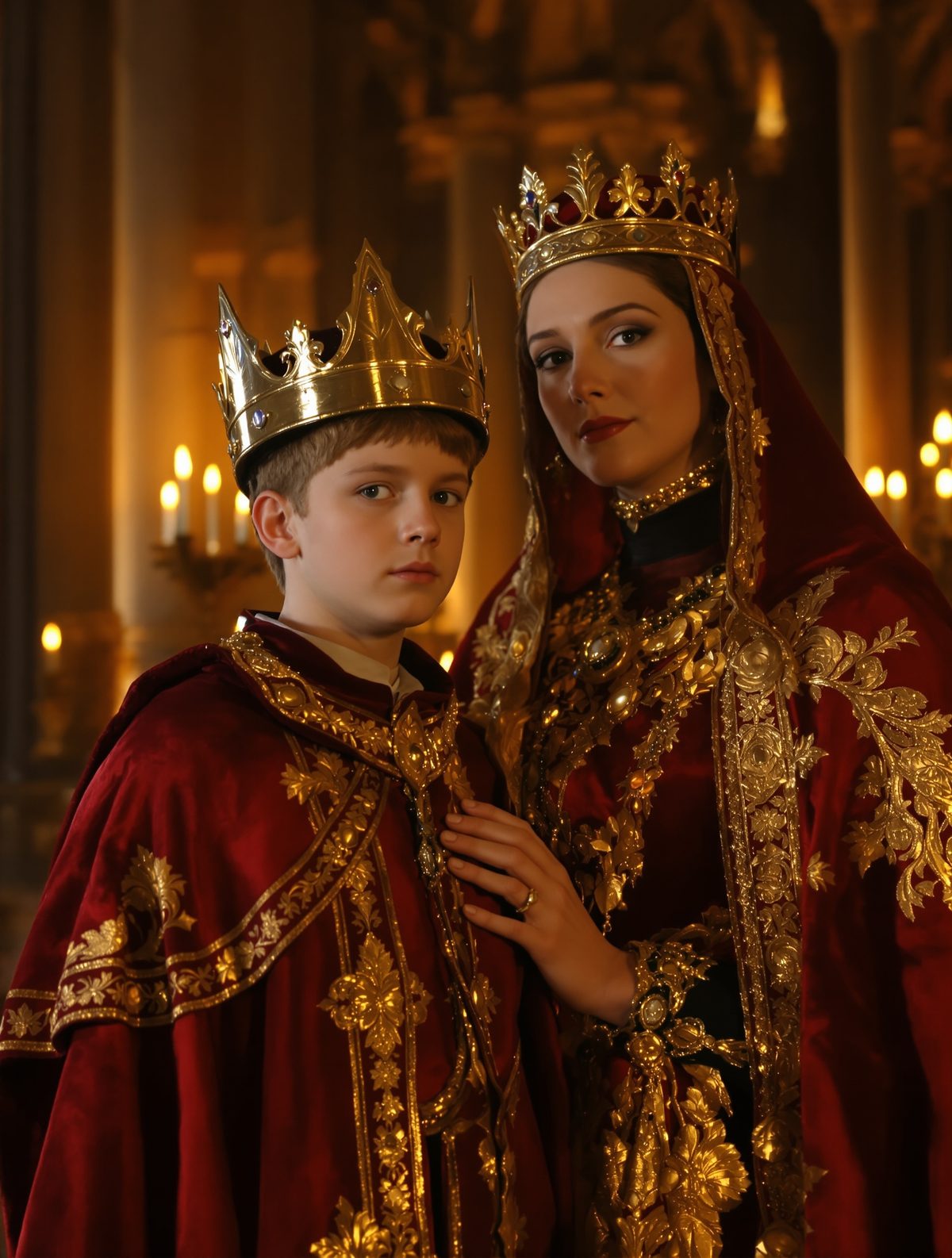
In the windswept autumn of 1216, turmoil gripped the heart of England. With the country embroiled in the First Barons' War and its king, John, recently buried, hopes for stability rested unexpectedly on the thin shoulders of his nine-year-old son, Henry. It was a moment of precarious greatness as the young boy stood at the center of a kingdom teetering on the edge of calamity. At his coronation, in the hallowed halls of Gloucester Cathedral, something remarkable happened. The crown, an imposing symbol of sovereignty, slipped down over his young head, threatening to obscure not just his eyes but also the future of the English monarchy. In that instant, it was his mother’s gentle hands, lifting and holding the crown aloft, that transformed a potential debacle into a poignant emblem of a dynasty's resurgence.
A boy king amidst a kingdom in crisis
The fall of 1216 was marked by sorrow and strife. King John had left a legacy blighted both by internal dissent and external threats. The country was divided by factions, with rebellious barons controlling much of the land and the French prince, Louis, challenging the throne. In this tumultuous landscape stood Prince Henry, soon to be Henry III, a boy barely old enough to comprehend the sweeping responsibilities ahead.
His youth, while a symbol of hope and renewal, was also a source of vulnerability. The Barons' War had strained the resources of the crown, and loyalty across England was fractured at best. Many questioned whether a child could lead the realm back from the brink; indeed, it was less about Henry himself at that tender age, and more about those who surrounded him, ready to shape and defend the fledgling king. Principal among these guardians was William Marshal, the first Earl of Pembroke, whose support and steady hand were instrumental in preserving the monarchy's continuity against considerable odds.
Gloucester Cathedral: A coronation under shadow
The coronation of King Henry III was unlike any other before it. Forced by the urgent need for stability, it took place not in the traditional confines of Westminster Abbey, but in Gloucester Cathedral. The setting was chosen for its strategic safety, as the capital and central sites were threatened by rebel forces. It was less grand ceremony and more a pragmatic assertion of rightful succession.
The modest coronation was not short on symbolism. There was no time to transport all the regalia from Westminster; thus, Henry was anointed with a simple circlet borrowed from his mother, the Dowager Queen Isabella. Yet, in that simplicity lay an earnest power — a visual reminder that monarchy is both a bloodline and a bond, sustained more by the people and relationships woven around it than by gold and jewels.
The crown slips: A mother's steadfast love
At the heart of this scarcely ostentatious ceremony was a profound human moment. As the crown, too large for Henry’s young head, began its slide, it was Isabella’s intervention that stilled the breath of uncertainty. Holding the crown, she did more than save an awkward moment; she reignited the faith in every observer that the monarchy would endure. Her quiet act of maternal protection and support resonated far beyond the cathedral’s walls, not just securing the coronation’s proceedings, but symbolizing a broader providence.
"It was not gold that kept the English crown aloft that day, but the unyielding resolve of a mother."
This act underscored a mother’s influence in shaping history — a beacon of strength for the fledgling king. The image of young Henry's ears nearly consumed by regal metal, juxtaposed with Isabella’s steadfast poise, fostered an eclipse of doubt in the minds of the gathered. It reminded the kingdom not just of inherited power, but of the human fortitude required to sustain it. A poignant reminder that while crowns may be heavy, they are supported by the unfailing love and determination of those who stand beside the throne.
An enduring legacy
Henry III's rule would indeed prove one of resilience and constructive legacy. Despite his tender beginnings, he reigned for 56 years, guiding England through periods of great challenge and renewal. His commitment to architectural achievements, most notably Westminster Abbey’s reconstruction, and the promotion of Gothic style, left an indelible architectural imprint matching his monarchy’s aspirations.
The crown that nearly hid him on that defining day in 1216 became a symbol of the stability he maintained through trustworthy alliances and diplomatic deftness. His reign wasn’t without its difficulties, of course — financial burdens and conflicts with noble factions would arise. Yet, it was his ability to bridge diverse interests, to honour tradition while embracing growth, that defined much of his legacy.
A royal lesson in resilience
Tales from the past often find echoes in the present, and the story of Henry III’s coronation resonates with modern perseverance. In an age where the monarchy’s role continuously evolves, it remains a touchstone for legacy and identity. The image of a mother lifting a crown embodies a timeless truth that transcends the trappings of royal estates or the gilded weight of heritage: the enduring strength of family and the fundamental acts of support can anchor history itself.
Today, as intrigue and interest swirl around contemporary royal duties, the inherent messages from the ceremony at Gloucester remind us of the monarchy's human core. The moments defining kings and queens are as much about who carries the mantle behind them as the figures themselves. The British monarchy has thrived not solely because of its potent symbols, but because of the people — resilient, often understated in resolve — who stand ready to act when history demands it.