The night before her coronation, a 27-year-old Elizabeth II faced a terrifying reality that no amount of royal protocol training could have prepared her for. The ancient St. Edward's Crown—the magnificent centerpiece of the most important ceremony of her life—was so impossibly heavy that she could barely keep her head upright during the final dress rehearsal. What should have been a triumphant final practice became a moment of genuine panic that nearly derailed the most watched royal event of the 20th century.
The Weight of History
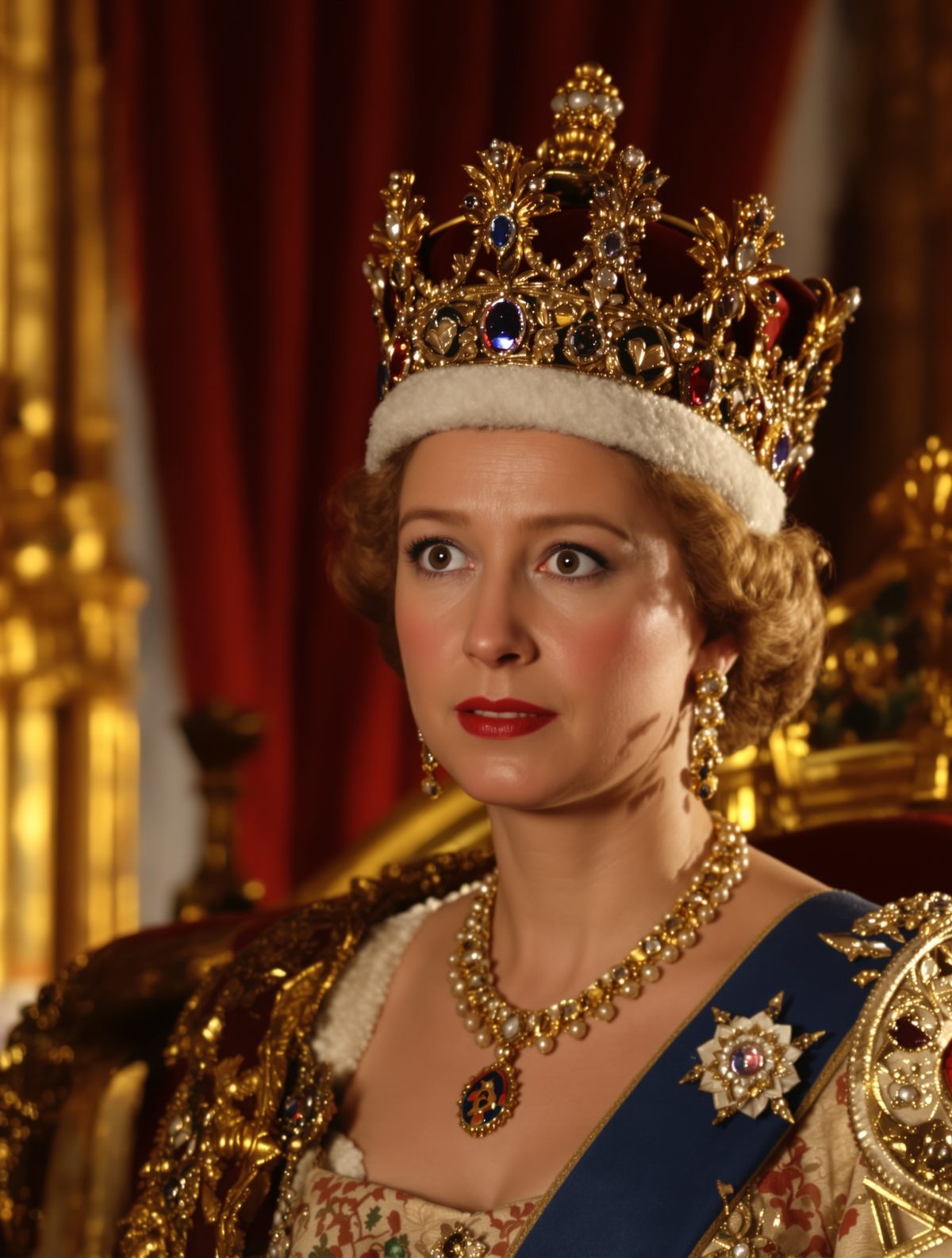
Standing in the private chambers of Buckingham Palace on the evening of June 1st, 1953, the young Queen discovered that wearing the crown of her ancestors was vastly different from the careful fittings she had endured in previous weeks. The St. Edward's Crown, crafted for the coronation of Charles II in 1661, weighs an imposing five pounds—a crushing burden when balanced atop one's head for hours during the most scrutinized ceremony in British history.
Palace staff watched in horror as their future monarch stumbled backward, her slender frame overwhelmed by the solid gold crown adorned with semi-precious stones. The crown's purple velvet cap, trimmed with ermine band, suddenly felt less like a symbol of divine authority and more like an instrument of torture. For a young woman who had never expected to inherit the throne until her uncle's abdication thrust her father into kingship, this was yet another reminder of the enormous responsibilities that fate had placed upon her shoulders.
The timing could not have been worse. With less than twelve hours until the ceremony would begin at Westminster Abbey, Elizabeth faced the very real possibility that she might not be physically capable of completing her own coronation. The weight of the crown was causing severe neck strain, and palace physicians worried about the potential for injury or, worse yet, a public stumble before the watching world.
Behind Palace Walls: A Night of Crisis
What followed was one of the most intense and secretive operations in royal history. While London slept in anticipation of the grand spectacle to come, Buckingham Palace became a hive of frantic activity. The Queen's dresser, her lady-in-waiting, and a small army of palace staff worked through the night to find solutions to what seemed like an impossible problem.
The challenge wasn't simply physical—it was deeply symbolic. The St. Edward's Crown had crowned monarchs for nearly three centuries. It represented an unbroken chain of sovereignty that connected Elizabeth to her illustrious predecessors. Switching to a lighter alternative was unthinkable, not just for historical reasons but because millions of people around the world were expecting to witness the traditional ceremony in all its ancient glory.
Palace insiders later revealed that the Queen demonstrated remarkable determination during those difficult hours. Rather than succumb to panic or consider alternatives, she insisted on finding a way to master the crown's demanding weight. "If my ancestors could bear it, then so shall I," became her unofficial motto for the evening, though the specific words of that private struggle remain locked in palace discretion.
The solution, when it came, was both simple and ingenious. Palace staff devised a series of exercises to strengthen Elizabeth's neck muscles and improve her posture, while simultaneously adjusting the crown's inner framework to distribute its weight more evenly. They also practiced a modified walking technique that would allow her to process down Westminster Abbey's lengthy nave without losing her balance.
The Art of Royal Endurance
What makes this story particularly fascinating is how it illuminates the hidden physical demands of royal ceremony. Modern audiences, accustomed to seeing the royals glide effortlessly through state occasions, rarely consider the genuine athletic endurance required for such events. The coronation ceremony would last nearly three hours, during which Elizabeth would need to maintain perfect composure while wearing not just the heavy crown, but also elaborate ceremonial robes that added additional weight and restricted movement.
The Queen's coronation gown, designed by Norman Hartnell, was itself a masterpiece of symbolic complexity. Embroidered with the floral emblems of the United Kingdom and Commonwealth realms in gold and silver thread, it weighed considerably more than a typical evening dress. Combined with the ceremonial jewelry and regalia, Elizabeth would be carrying the equivalent of a small child's weight in precious metals and historic artifacts.
Palace records suggest that the overnight training session proved remarkably effective. By dawn on June 2nd, the Queen had developed both the physical technique and mental confidence necessary to wear St. Edward's Crown with apparent ease. Her success speaks to both her personal determination and the extraordinary dedication of the palace staff who worked tirelessly to ensure the ceremony's success.
A Triumph Born from Near Disaster
When Queen Elizabeth II finally processed into Westminster Abbey on the morning of June 2nd, 1953, the 8,251 guests gathered in the ancient church witnessed what appeared to be a flawless performance. Television audiences around the world—an estimated 277 million viewers—saw a young monarch who carried herself with serene dignity and apparent effortless grace.
The irony was exquisite: what looked like natural royal bearing was actually the product of the most intensive crash course in ceremonial deportment in modern royal history. Every step down the abbey's nave, every carefully controlled head movement during the complex liturgy, represented hours of desperate practice in the final moments before the ceremony.
The Archbishop of Canterbury, Geoffrey Fisher, who conducted the coronation service, later praised the Queen's remarkable composure throughout the lengthy ceremony. He had no idea that her steady presence was the result of a night-long battle with five pounds of medieval goldsmithing that had nearly defeated her mere hours before.
Perhaps most remarkably, Elizabeth's mastery of the crown proved so complete that she wore it with apparent comfort throughout the entire service. The moment when Archbishop Fisher lowered the St. Edward's Crown onto her head—the culmination of over a thousand years of English royal tradition—revealed no hint of the previous evening's struggles.
Legacy of Strength
The story of Queen Elizabeth II's coronation dress rehearsal disaster offers a profound insight into the character that would define her remarkable seventy-year reign. Faced with an apparently insurmountable challenge at the most crucial moment of her royal life, she chose determination over defeat, practice over panic, and personal strength over royal privilege.
This hidden chapter of coronation history also illuminates the extraordinary dedication of the palace staff who served the Crown with such devotion. Their willingness to work through the night to solve an unprecedented crisis speaks to the deep institutional loyalty that has sustained the monarchy through centuries of change and challenge.
Today, as we look back on that extraordinary reign that began with such private drama, we can see how that night of crisis perhaps foreshadowed the quiet resilience that became Elizabeth II's defining characteristic. The young woman who refused to be defeated by the weight of St. Edward's Crown went on to carry the far heavier burden of modern monarchy with the same steady grace she displayed on her coronation day.
The crown that nearly ruined everything became the perfect symbol of a reign built on determination, duty, and an unshakeable commitment to service. Sometimes the most magnificent performances in royal history begin with the most private struggles—and Elizabeth II's coronation remains the most beautiful example of triumph emerging from the edge of disaster.