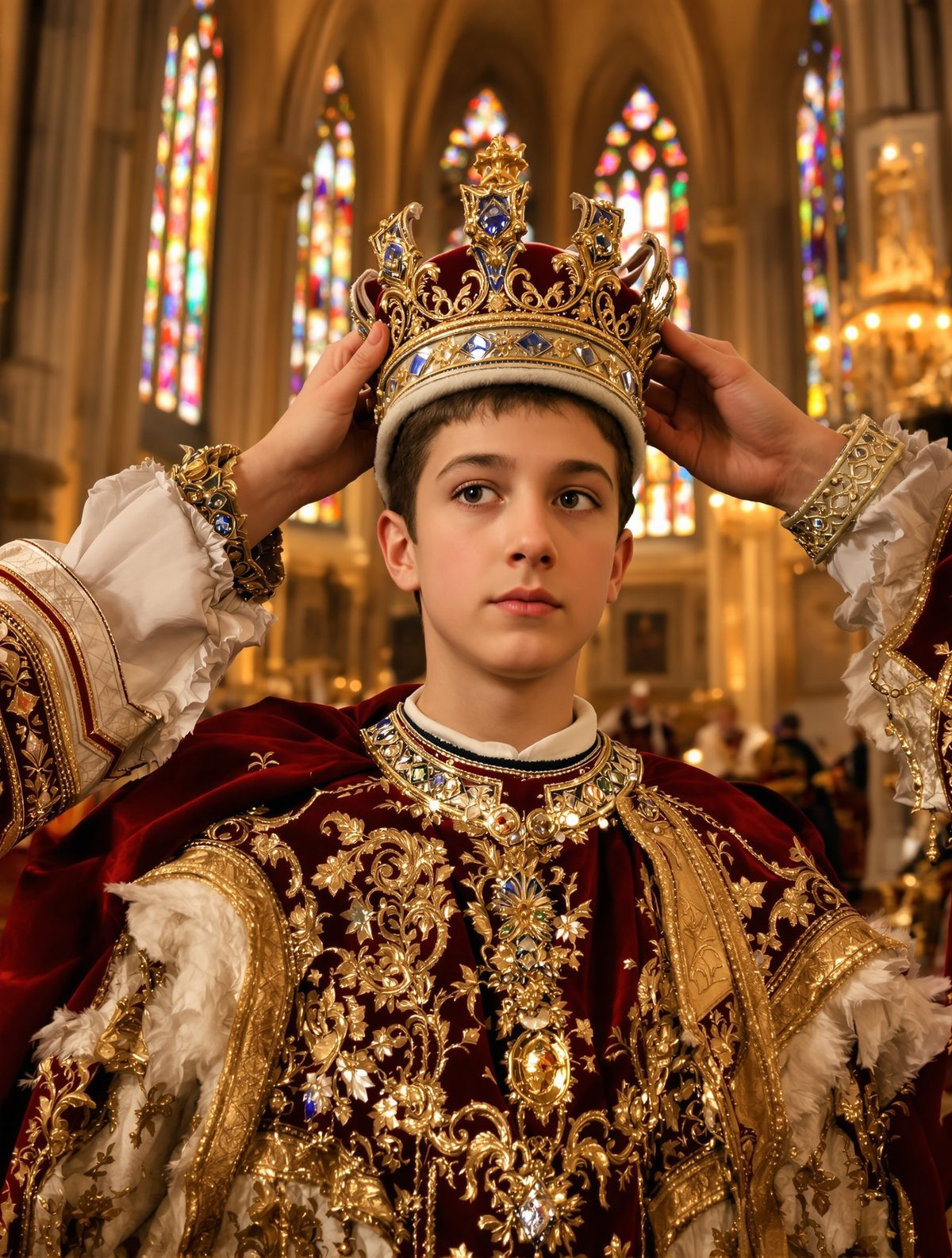
On a bitter December morning in 1431, the ancient stones of Notre Dame Cathedral witnessed one of the most extraordinary—and heartbreaking—scenes in royal history. A ten-year-old English boy, his small frame dwarfed by ceremonial robes, stood trembling before the altar as the weight of two kingdoms literally and figuratively bore down upon him. King Henry VI was about to become the youngest monarch ever crowned in Paris, and the only person in history to wear both the English and French crowns. Yet this moment of supposed triumph would reveal not the strength of English dominance, but the profound vulnerability of a child thrust into an impossible position.
A Crown Too Heavy for Small Shoulders
The coronation of Henry VI as King of France was unlike any ceremony Notre Dame had ever hosted. The French crown jewels, magnificent symbols of centuries of Capetian and Valois rule, had been carefully transported to Paris for the occasion. Yet when the moment came to place the crown upon the boy's head, courtiers quickly realized that the ancient diadem was simply too heavy for the child to bear.
Contemporary accounts describe how the crown had to be held suspended above Henry's head throughout much of the ceremony, a detail that seems almost prophetic in hindsight. Here was a king who could not even physically support the weight of his supposed authority, let alone wield it effectively. The symbolism was lost on none of the assembled nobles, French and English alike, who watched this unprecedented spectacle unfold.
Young Henry, overwhelmed by the grandeur and solemnity of the occasion, reportedly whispered to his uncle, John of Lancaster, Duke of Bedford, that he wished to return home to England. This poignant moment captures the essential tragedy of Henry's reign—a sensitive, gentle soul forced into a role that would have challenged even the most seasoned monarch.
The Political Theater of Occupied Paris
The decision to crown Henry in Paris was no mere ceremonial flourish but a calculated political move by the English regency council. Following Henry V's stunning victories at Agincourt and subsequent conquests, the Treaty of Troyes in 1420 had recognized Henry V and his heirs as the rightful rulers of France. When Henry V died unexpectedly in 1422, his infant son inherited not only the English throne but also the most audacious claim in medieval Europe—dominion over France itself.
By 1431, however, the English position in France had become increasingly precarious. A peasant girl from Orléans had rallied French resistance and seen the Dauphin crowned as Charles VII in Reims Cathedral earlier that year. Joan of Arc's remarkable campaign had shattered the myth of English invincibility and reignited French national sentiment. The English response was to stage their own coronation, asserting their legitimacy through the sacred rituals of kingship.
Notre Dame was chosen deliberately—while Reims was the traditional coronation site for French kings, Paris remained under English control and represented the heart of French political power. The cathedral's soaring Gothic arches had witnessed centuries of royal ceremonies, and now they would host the most unusual of all: the crowning of a foreign child as King of France.
A Court in Exile
The young Henry's court was a fascinating blend of English nobility and French collaborators who had thrown their lot in with the Lancastrian cause. His uncle, the Duke of Bedford, served as regent and had worked tirelessly to maintain English control over northern France. Bedford was a capable administrator and military commander, but even he must have recognized the challenges of governing through a child king who displayed little appetite for the warrior-kingship that his father had embodied.
The coronation ceremony itself was conducted with all the magnificence the English could muster, yet it lacked the organic legitimacy of a truly French celebration. Many of the great French noble families were notably absent, having either fled to support Charles VII or remaining diplomatically neutral. The congregation, while impressive, felt hollow—a performance of power rather than a genuine expression of it.
Henry's own temperament made him an unlikely conqueror. Contemporary accounts describe a pious, scholarly boy more interested in religious devotions than military campaigns. He would later found both Eton College and King's College, Cambridge, legacies that far outlasted his political achievements. But in 1431, these gentle qualities served only to highlight the incongruity of his position as a conquering monarch.
The Unraveling of a Dual Monarchy
The coronation in Notre Dame represented both the high-water mark and the beginning of the end for English pretensions to the French throne. Despite the pageantry, Henry's authority in France would prove ephemeral. Joan of Arc had already transformed the conflict from a feudal dispute into something resembling a national liberation struggle, and her martyrdom only intensified French resistance.
Within two years of his coronation in Paris, Henry had returned to England, never again to set foot in France as its supposed king. The dual monarchy that had been his father's greatest achievement slowly crumbled as English resources were stretched thin and French morale soared under their newly confident Dauphin, now definitively Charles VII.
Henry's personal struggles with mental health, which would manifest more clearly in adulthood, may have had their roots in the impossible pressures placed upon him as a child. The weight of that suspended crown was nothing compared to the psychological burden of being expected to hold together an empire that was already fracturing around him.
Legacy of a Moment
The image of ten-year-old Henry VI in Notre Dame—trembling, overwhelmed, asking to go home—serves as a powerful reminder of the human cost of political ambition. Here was a child sacrificed to the dreams of his dead father and the machinations of regents who perhaps believed their own propaganda about English destiny.
Today, as we watch young members of the modern Royal Family grow up in the public eye, there are echoes of Henry's story. The institution of monarchy has evolved to protect its youngest members far better than medieval custom allowed, yet the fundamental tension between personal happiness and public duty remains. When we see Prince George or Princess Charlotte at state occasions, we might remember that vulnerable boy in Paris, and be grateful for how much more carefully we now nurture our royal children.
The coronation of Henry VI in Notre Dame stands as one of history's most poignant examples of crown versus childhood—a reminder that even in the rarefied world of royalty, some burdens are simply too heavy for young shoulders to bear, no matter how many courtiers stand ready to help hold them up.