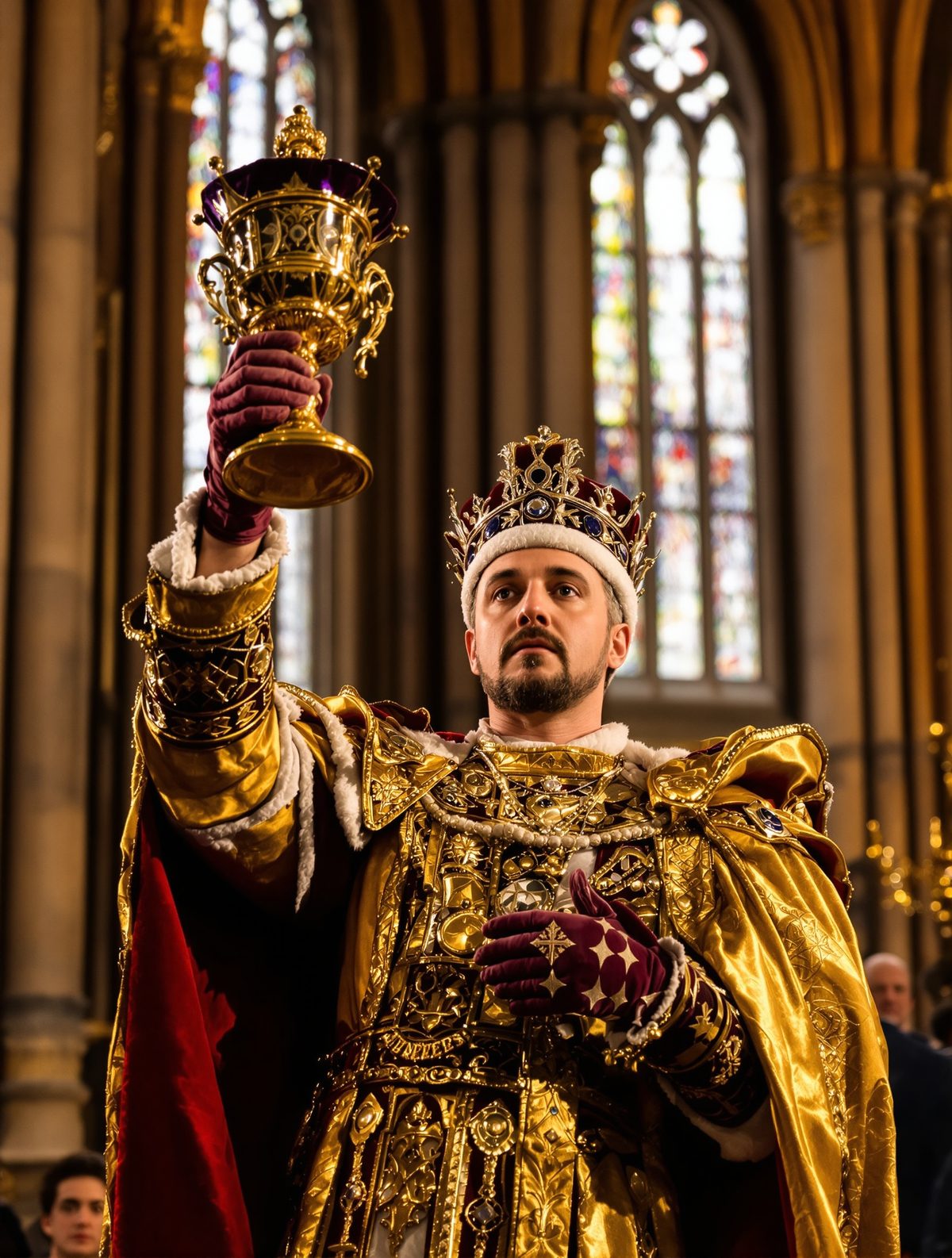
The golden chalice trembled slightly in King James I's hands as he stood before the assembled nobility of England in Westminster Abbey on July 25, 1603. The elaborate coronation ceremony had proceeded flawlessly—the ancient rituals performed, the crown placed upon his head, the oaths sworn. But now, in what should have been a moment of pure triumph for England's new monarch, something unprecedented was about to unfold. As James raised the ceremonial cup to his lips for the traditional blessing, his whispered words would reveal a truth that many in the Abbey were not prepared to hear.
A Scottish King for an English Throne
James VI of Scotland's journey to become James I of England had been decades in the making. The son of the ill-fated Mary, Queen of Scots, he had ruled Scotland since he was barely a year old, though real power had been wielded by regents until his teens. By 1603, when Elizabeth I died childless, James was an experienced monarch with thirty-six years of Scottish kingship behind him.
The transition itself had been remarkably smooth—a testament to the careful political groundwork laid in Elizabeth's final years. Robert Cecil, Elizabeth's chief minister, had secretly corresponded with James for months, ensuring the succession would proceed without the civil war that many had feared. When Elizabeth breathed her last at Richmond Palace in the early hours of March 24, 1603, James was proclaimed king within hours.
Yet beneath this apparent seamlessness lay profound tensions. England was accepting a foreign king—and not just any foreigner, but a Scottish one. The two kingdoms had been enemies for centuries, and many English nobles harbored deep suspicions about their new monarch's true loyalties. Would James govern as an English king who happened to be Scottish, or as a Scottish king who had simply acquired England as an additional realm?
The Weight of Westminster's Expectations
Westminster Abbey on coronation day was a carefully orchestrated display of English majesty and tradition. The ceremony itself dated back centuries, every element designed to emphasize the sacred nature of English kingship and the new monarch's bond with his English subjects. Archbishop John Whitgift, despite his advanced age and failing health, had insisted on performing the ceremony himself—a final act of service to the English church and crown.
The assembled congregation represented the cream of English society. Earls and dukes, bishops and judges, all had come to witness their new king's sacred commitment to England. Many had never seen James before this day, and they scrutinized every gesture, every word, for clues about the kind of ruler he would prove to be.
The coronation regalia itself told the story of English royal power: Edward the Confessor's Crown, St. Edward's Staff, the Spurs of Chivalry. Each piece connected James to the long line of English kings stretching back through the Tudors, the Plantagenets, and beyond. It was theater, certainly, but theater with profound political purpose.
The Toast That Changed Everything
What happened next would be remembered and whispered about in court circles for years to come. As James lifted the ceremonial chalice, tradition called for him to offer a blessing upon England and his English subjects. Instead, contemporary accounts suggest that the king's first toast was to Scotland—his beloved homeland, which he had left behind forever when he journeyed south to claim Elizabeth's throne.
The reaction was immediate and unmistakable. Archbishop Whitgift, already weakened by age, appeared stunned into silence. The nobles closest to the altar exchanged glances of confusion and concern. Had they heard correctly? Had their new king just proclaimed his primary allegiance to the kingdom he had left behind rather than the one he was being crowned to rule?
The silence that fell over Westminster Abbey was profound and uncomfortable. This was not mere protocol being breached—this was a public declaration of where James's heart truly lay, made at the very moment when he should have been pledging himself wholly to England.
A King Divided
To understand James's extraordinary gesture, one must appreciate the genuine anguish he felt at leaving Scotland. Despite the greater wealth and prestige of the English throne, James had been deeply reluctant to abandon his northern kingdom. He had spent months agonizing over the details of how Scotland would be governed in his absence, ultimately leaving the country in the hands of a Privy Council but retaining ultimate authority himself.
James's correspondence from this period reveals a man torn between duty and affection. Scotland was not merely his birthplace—it was his identity. He had shaped and been shaped by Scottish politics, Scottish religion, and Scottish culture. The idea of becoming an "English" king was, in many ways, fundamentally foreign to his sense of self.
Moreover, James harbored grand ambitions for uniting the two kingdoms into a single British realm. His toast to Scotland first may have been his way of signaling that he saw himself not as an English king, but as the monarch of both kingdoms equally—with Scotland, as his original realm, holding a special place in his heart.
The Long Shadow of a Single Moment
The immediate aftermath of James's coronation toast set the tone for much of his English reign. While he would go on to rule England for twenty-two years, he never fully shook the perception among many English nobles that he remained, at heart, a Scottish king. His efforts to promote closer union between the kingdoms were repeatedly frustrated by English parliamentary resistance, with many MPs arguing that such union would benefit Scotland at England's expense.
James's favoritism toward Scottish courtiers who followed him south only reinforced these concerns. Men like Robert Carr and George Villiers rose to extraordinary heights of power and wealth, while established English noble families found themselves increasingly marginalized. The king's Scottish accent, his informal manner, and his passionate advocacy for his homeland all served as constant reminders of his foreign origins.
Yet perhaps James's coronation day declaration was more honest than politic. He was Scottish, and no amount of English ceremonial could change that fundamental fact. His toast to Scotland first was a moment of authentic emotion in a day otherwise scripted for maximum political effect.
Four centuries later, as the British monarchy continues to navigate questions of identity and belonging across the constituent nations of the United Kingdom, James I's coronation day toast feels remarkably contemporary. In an age when royal family members are increasingly expected to embody the diverse, multinational character of modern Britain, perhaps there was something admirable in James's refusal to pretend he was other than what he was—a Scottish king who loved his homeland, even as duty called him to rule a larger realm.