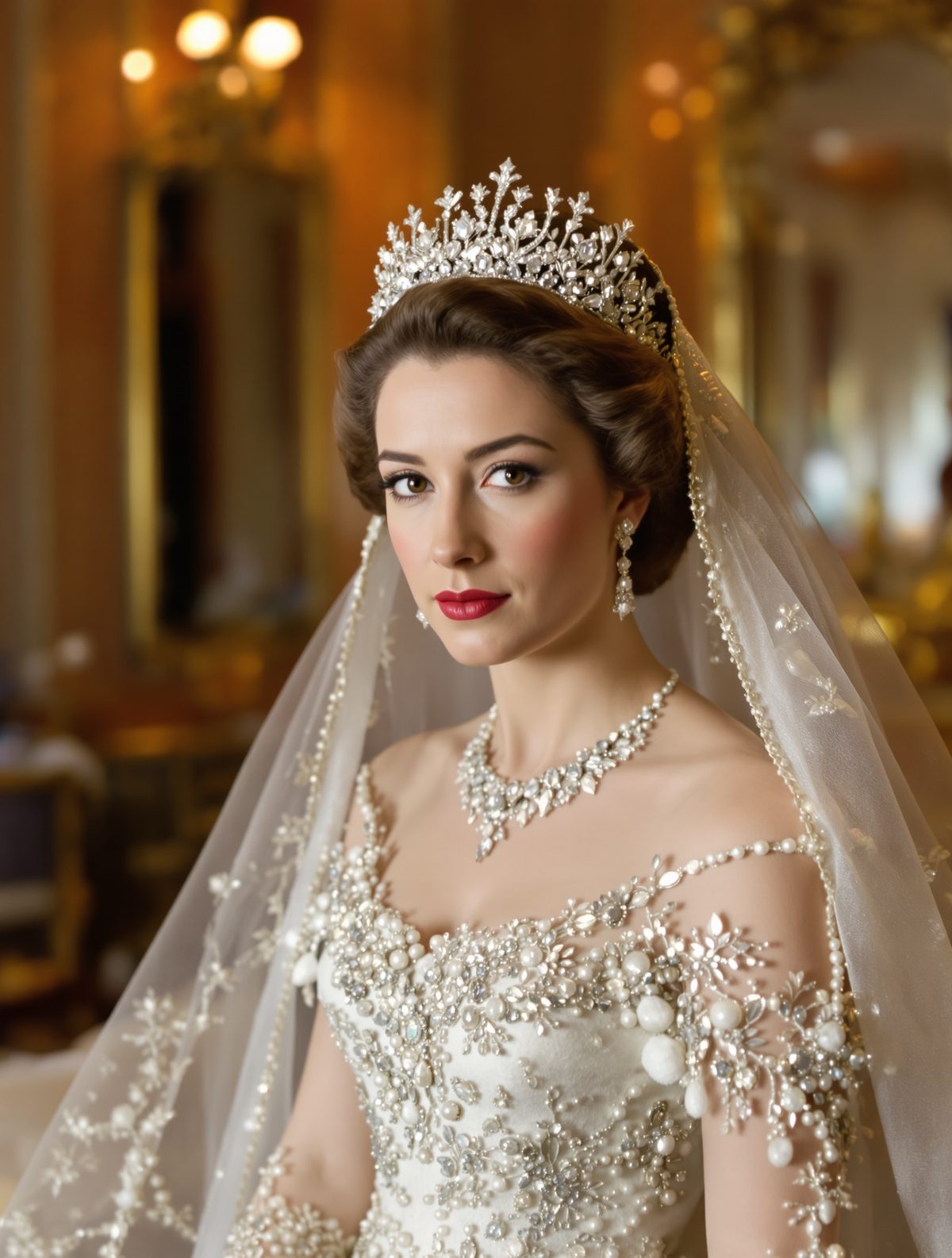
In the pre-dawn darkness of November 20, 1947, panic gripped Buckingham Palace. Princess Elizabeth, just 21 years old and hours away from marrying Prince Philip in what would become one of the most watched royal weddings in history, stood in her dressing room surrounded by chaos. Her exquisite Norman Hartnell wedding gown hung damaged, her grandmother Queen Mary's diamond fringe tiara lay broken in two pieces, and her 15-foot silk tulle veil bore an ugly tear. With Westminster Abbey already filling with dignitaries from across the globe, the future Queen faced every bride's worst nightmare—but this was no ordinary wedding, and Elizabeth was no ordinary bride.
The Dress That Nearly Wasn't
Norman Hartnell had outdone himself with Princess Elizabeth's wedding dress, creating what many still consider one of the most beautiful royal wedding gowns ever made. Constructed from duchesse satin with a fitted bodice, full skirt, and intricate embroidery featuring 10,000 imported seed pearls and crystals, the dress was a masterpiece of post-war craftsmanship. The design incorporated symbols of rebirth and new beginnings—star flowers, orange blossoms, ears of wheat, and white York roses—all painstakingly hand-sewn by the palace seamstresses.
But during the final dress rehearsal on the evening of November 19th, disaster struck. The exact details of what happened remain somewhat unclear in the royal archives, but according to palace staff who were present, a combination of factors led to the near-catastrophe. The heavy pearls and crystals had begun pulling at the delicate silk thread, causing small tears in the bodice embroidery. More alarming still, the dress's complex internal structure—a marvel of 1940s corsetry and engineering—had shifted during the fitting, creating an unflattering and uncomfortable fit.
The tiara incident, however, was the most dramatic of all. Queen Mary's diamond fringe tiara, crafted in 1919 and featuring 47 diamond bars, had been the Queen Mother's choice for her daughter. But as Elizabeth's hairdresser attempted to secure it for the rehearsal, the antique setting gave way under the weight of the diamonds, snapping cleanly in half. The sound, witnesses later recalled, was like a gunshot echoing through the palace corridors.
A Royal Crisis Behind Closed Doors
What happened next revealed both the remarkable efficiency of the royal household and the unflappable character that would define Elizabeth's 70-year reign. Rather than dissolving into tears or panic, the young princess immediately took charge of the situation. Palace staff were summoned, and within minutes, Buckingham Palace had transformed into something resembling a wartime command center.
The royal seamstresses, led by Hartnell's head seamstress, worked through the night in shifts. Using magnifying glasses and working by lamplight, they carefully removed and re-secured every loose pearl and crystal. The dress's internal structure was completely rebuilt, with additional stays and supports added to prevent any further mishaps. Meanwhile, in another part of the palace, the court jeweler worked frantically with "very strong glue"—likely an early industrial adhesive—and fine wire to repair Queen Mary's tiara.
The backup plan was almost too dramatic to believe. If the tiara could not be repaired in time, Princess Elizabeth was prepared to wear a simple wreath of orange blossoms—the traditional Hanoverian wedding headpiece. This would have been a striking departure from royal tradition, but as one courtier noted in their diary, "Her Royal Highness showed remarkable composure and declared she would marry Philip wearing a paper crown if necessary."
The Human Side of Royal Perfection
These frantic hours before the wedding revealed something rarely seen in royal circles: the very human anxiety and excitement of a young woman about to marry the man she loved. Despite the chaos surrounding her, Princess Elizabeth spent part of the night writing thank-you notes to well-wishers and checking on the comfort of her bridesmaids, who were staying at the palace.
Prince Philip, staying at the nearby Dorchester Hotel as royal protocol demanded, remained unaware of the crisis until years later. The decision to keep him in the dark came from Elizabeth herself, who reportedly said she didn't want him worrying about things beyond his control on their wedding morning. This thoughtfulness, even in the midst of her own crisis, would become a hallmark of her character as Queen.
The veil presented its own challenges. The 15-foot length of silk tulle, attached to Queen Mary's tiara, had caught on a door frame during the rehearsal and torn near the crown. Palace seamstresses worked with threads so fine they were nearly invisible, creating an invisible mend that can still be seen today when the dress is displayed—if you know exactly where to look.
Dawn Brings Salvation
As the November sun rose over London, bringing with it the most important day in young Princess Elizabeth's life, the palace crisis team had worked their magic. The tiara, though bearing the scars of its emergency repair (visible in close-up photographs from the day), held firm. The dress, with its reconstructed bodice and re-secured embellishments, looked even more magnificent than before.
But perhaps the most remarkable aspect of the entire episode was how completely it was hidden from the public and press. In an age before social media and instant communication, the palace was able to maintain complete secrecy about the near-disaster. Not a single newspaper reported the crisis, and it wasn't until decades later that details began to emerge in memoirs and royal biographies.
The wedding itself was flawless. Princess Elizabeth walked down the aisle of Westminster Abbey looking radiant, her repaired tiara catching the light from the television cameras that were broadcasting the ceremony to millions around the world. The dress moved beautifully, the tiara stayed perfectly in place, and the only sign of the previous night's drama was perhaps the extra-bright smile of relief on the face of Norman Hartnell, who watched from the congregation.
A Queen's Grace Under Pressure
Looking back on this wedding dress disaster from the perspective of today, it's impossible not to see it as a perfect metaphor for Elizabeth's approach to monarchy. Throughout her long reign, she would face numerous crises—political, personal, and constitutional—with the same calm determination she showed on that chaotic November night in 1947.
The incident also highlights the extraordinary dedication of the people who served the royal family. The seamstresses who worked through the night, the jeweler who performed emergency surgery on a priceless tiara, the palace staff who kept the crisis secret—all demonstrated the kind of devotion that made the post-war royal household function so effectively.
Today, as we watch modern royal brides like Catherine, Duchess of Cambridge, and Meghan, Duchess of Sussex, glide down Westminster Abbey's aisle in seemingly perfect gowns, it's worth remembering that behind every flawless royal moment lies careful planning, dedicated craftspeople, and sometimes, a very long night of emergency repairs. Princess Elizabeth's wedding dress disaster reminds us that even the most polished royal occasions can hang by a thread—sometimes literally—and that true grace lies not in avoiding problems, but in how one handles them when they arise.