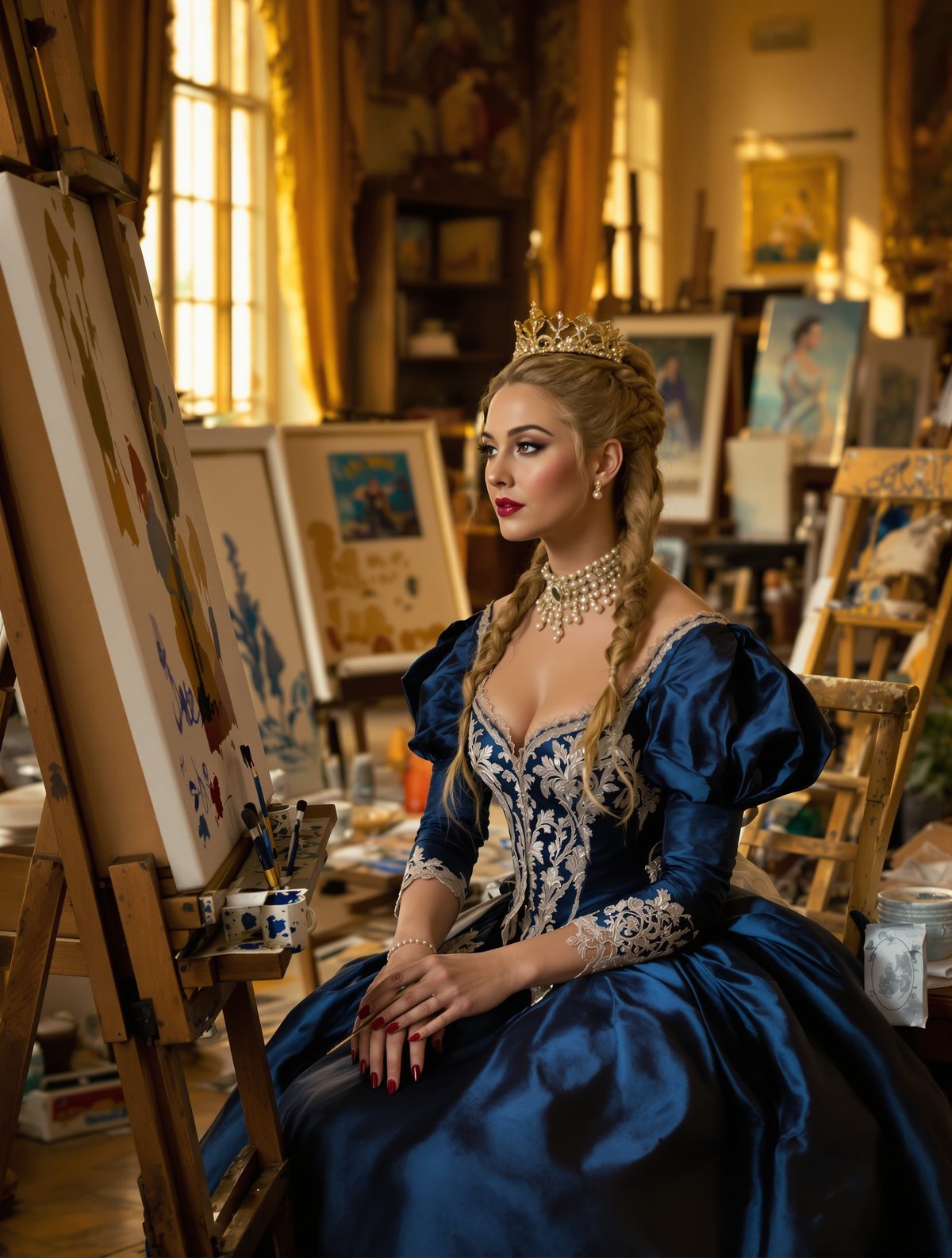
In the gaslit studios of Victorian London, a mysterious young woman bent over her easel, carefully shaping clay with calloused hands that betrayed hours of dedicated practice. Her fellow students knew her simply as "Louise," an earnest art pupil who attended classes with remarkable dedication. What they didn't know was that royalty sat beside them—Queen Victoria's fourth daughter had embarked on one of the most daring deceptions in royal history, trading her tiara for a simple bonnet and her palace privileges for the democratic world of artistic education.
A Princess with Artistic Ambitions
Princess Louise Caroline Alberta, born in 1848, was never destined to be an ordinary royal daughter. From childhood, she displayed an independent streak that both delighted and concerned her formidable mother, Queen Victoria. While her sisters Princess Vicky and Princess Alice focused on traditional royal pursuits and advantageous marriages, Louise harbored dreams that extended far beyond the palace walls.
The princess possessed genuine artistic talent that became evident early in her youth. Unlike the typical royal dabbling in watercolors—considered an appropriately feminine accomplishment—Louise demonstrated serious sculptural abilities and a passion for the fine arts that demanded proper training. However, the rigid protocols of the 1860s court made such aspirations nearly impossible for a daughter of the Queen-Empress.
Royal daughters were expected to marry well, support charitable causes, and maintain the dignity of the Crown through carefully choreographed public appearances. The idea of mingling with commoners in art studios, getting her hands dirty with clay, and subjecting her work to the criticism of professional instructors was virtually unthinkable. Yet Louise possessed the determination—and cleverness—to pursue her artistic dreams regardless of convention.
The Great Deception Begins
In the late 1860s, Princess Louise conceived an audacious plan that would have scandalized Victorian society had it been discovered. With careful preparation and the discreet assistance of trusted allies, she arranged to enroll at the National Art Training School in South Kensington under an assumed identity.
The National Art Training School, established in 1837, was the premier institution for artistic education in Britain, attracting talented students from across the social spectrum. The school's democratic approach to merit-based instruction made it the perfect environment for Louise's experiment in anonymity. Here, talent mattered more than titles, and artistic ability could elevate a student regardless of their background.
Louise's disguise required meticulous attention to detail. Gone were the elaborate gowns and jewels that marked her royal status. Instead, she adopted the practical dress of a middle-class art student: simple dark skirts, plain blouses, and sturdy shoes suitable for standing long hours in studios. Her distinctive royal bearing had to be carefully modulated, her speech patterns adjusted to blend seamlessly with her fellow students.
The princess's ability to maintain this charade speaks to both her acting skills and her genuine desire to be treated as an equal in the artistic community. For months, she attended classes, participated in critiques, and developed friendships with students who had no idea they were sharing their lunch with a member of the royal family.
Life Among the Commoners
The experience of attending art school under a false identity provided Princess Louise with unprecedented insight into the lives of ordinary Britons. In the studios of South Kensington, she encountered ambitious young people from merchant families, clergy households, and even working-class backgrounds—all united by their passion for artistic expression.
Louise threw herself into her studies with remarkable dedication. She attended sculpture classes, mastering the techniques of working with clay and stone that would later make her one of the most accomplished royal artists in history. Her instructors noted her exceptional commitment and natural talent, unaware that they were teaching a princess who could have commanded private tutors from the most celebrated artists in Europe.
The democratic atmosphere of the art school must have been revelatory for a young woman raised in the rarefied world of royal palaces. Here, success depended entirely on merit, criticism was offered based on artistic achievement rather than social status, and friendships formed around shared creative interests rather than political alliances.
Fellow students later recalled "Louise" as a dedicated and talented pupil who seemed unusually well-educated and possessed of remarkable poise. Some noted her particular knowledge of art history and classical subjects, but attributed this to exceptional self-education rather than royal tutors. Her ability to maintain this facade while genuinely engaging with her studies demonstrates both her acting abilities and her sincere commitment to artistic development.
The Royal Secret Revealed
The princess's remarkable deception eventually came to light, though historical accounts vary on exactly how her identity was discovered. Some sources suggest that a sharp-eyed instructor began to suspect something unusual about the exceptionally well-spoken and poised "Louise." Others indicate that the secret was deliberately revealed after several months when it became clear that maintaining the charade indefinitely would be impossible.
When the truth emerged, the reaction among her fellow students was reportedly one of amazement rather than anger. The democratic spirit of the art school meant that Louise had already proven herself through her talent and dedication. Her royal status became an interesting footnote to relationships built on genuine artistic camaraderie.
The revelation also highlighted the remarkable success of Louise's experiment in equality. She had demonstrated that royal blood carried no special artistic privileges—her achievements in the studio were earned through the same hard work and natural ability required of any student. This validation of meritocratic principles aligned perfectly with the progressive ideals that would characterize much of Louise's later life.
News of the princess's artistic education eventually reached broader society, where reactions were mixed. Progressive voices praised her dedication to serious artistic study, while more conservative elements worried about the propriety of a royal daughter mingling so freely with commoners. Queen Victoria's own reaction, while not extensively documented, appears to have been relatively tolerant—a testament to Louise's skillful management of her double life.
A Legacy of Artistic Achievement
Princess Louise's audacious adventure in artistic education paid remarkable dividends throughout her life. The skills she developed at the National Art Training School, combined with her natural talent, established her as one of the most accomplished royal artists in British history. Her sculpture of Queen Victoria, unveiled at Kensington Palace, stands as a testament to the professional-level training she received during her months of disguise.
Beyond her personal artistic achievements, Louise's experience highlighted important questions about women's education, social mobility, and the role of merit versus birth in Victorian society. Her successful navigation of both royal and common worlds demonstrated possibilities that few of her contemporaries could imagine.
The princess's story resonates particularly strongly today, when members of the royal family routinely attend universities and pursue professional training alongside their future subjects. What seemed scandalously democratic in the 1860s now appears remarkably prescient. Princess Louise's artistic adventure anticipated the modern royal approach to education and public service, where personal development and genuine expertise complement traditional ceremonial duties.
Her courage in pursuing serious artistic education, despite significant social obstacles, established a precedent that continues to influence royal attitudes toward learning and achievement. In trading her palace privileges for the authentic experience of artistic training, Princess Louise demonstrated that the most valuable royal qualities—dedication, intelligence, and genuine accomplishment—shine brightest when tested in the democratic arena of merit-based achievement.