
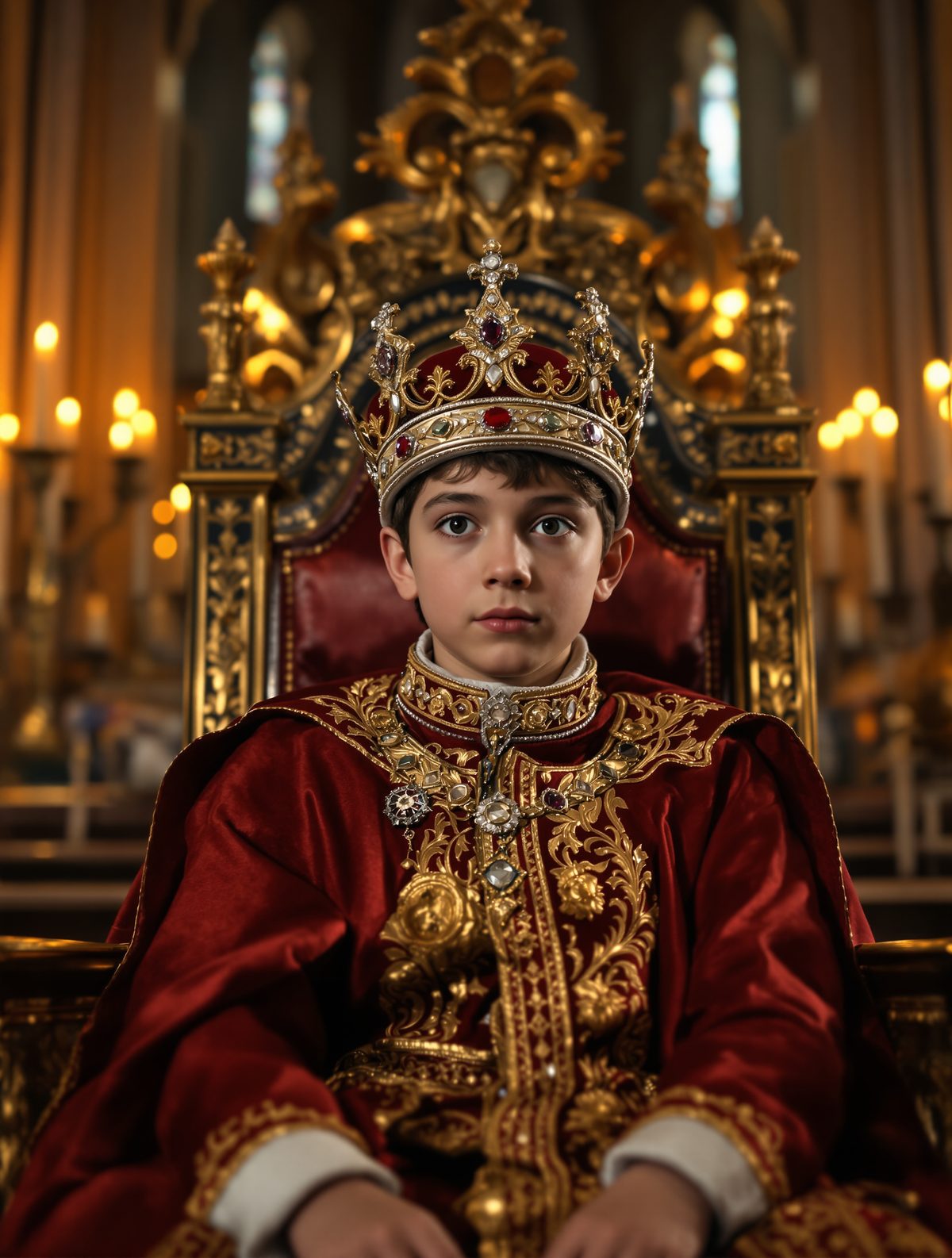
In December 1431, the towering gothic spires of Notre Dame Cathedral stood sentinel over Paris, bearing witness to an extraordinary spectacle that would echo through history. A mere boy, not yet eleven, was to be crowned King of France. This boy was Henry VI of England, an orphan monarch caught in the relentless storm of medieval politics, his fate woven into the complex tapestry of The Hundred Years' War. Before this day, none in England's storied past had borne the weight of two crowns, nor would any evade the relentless march of life so wholly again.
The Child Monarch of Two Realms
For those gathered in the cool, echoing aisles of Notre Dame, it was no ordinary coronation. As Henry VI made his way through the ornate expanse of the cathedral, the illusion of royal power was juxtaposed by his own boyish fragility. His coronation as King of France was a singular moment marking the height of English influence across the Channel, though wrought under the most human of personal tragedies.
Born December 6, 1421, at Windsor Castle, Henry was the only child of King Henry V and Catherine of Valois, a French princess. His father's triumph at the Battle of Agincourt had carved a fragile English hegemony into French soil. However, before the boy could walk, he became acutely emblematic of national ambitions and losses. By 1422, his father had succumbed to illness and Henry became not only the King of England but, nominally, of France, as per the Treaty of Troyes which declared him heir to the French throne.
Yet this title was more than symbolic. For his guardians, crowned regents who included his uncle, the Duke of Bedford, it was imperative to solidify England's claim to France by formally crowning the young king in Paris—a weighty decision made more challenging by the winds of conflict that never truly ceased in those decades of war.
Through the Doors of Notre Dame
The atmosphere inside Notre Dame that day was tense with expectation. The history, architecture, and aspirations contained within its venerable walls absorbed the hush of the attending nobles and clergy. Their eyes were fixed on the central nave as Henry, dressed in opulent robes too large for his slender frame, approached the altar. His steps were tentative yet imbued with a grace only youth could bestow upon such a daunting mission.
While some records of the coronation day have been lost or obscured by time, many agree on the poignant image of King Henry weeping throughout the ceremony. It was a human moment amidst grandeur, a child bearing burdens that might break men. The renowned historian, Norman Davis, describes the event as one of quiet majesty tempered by the somber reality of war; an observance both grand and sorrowful, sealed in the silent tears of a boy who understood all too well the immensity of his crown.
The crown itself—heavy and gleaming, an icon of authority—seemed vast on his youthful brow. It signified not just the rule over lands but the ambiguity of identity that would come to define Henry's reign. Through the Latin liturgy and the blessing chants of the assembled archbishops, a question lingered: could this script of destiny for England’s royal child ever be played to completion?
The Royal Court and Its Ramifications
The royal court of England in the 1430s was nothing if not factionalized. Henry's minority saw power wrestled over by feuding lords whose ambitions often ran counter to the stability of the realm. His uncles, John, Duke of Bedford, and Humphrey, Duke of Gloucester, jostled for regency and influence, their mutual antipathy a longstanding saga of political maneuvering.
In France, however, English rule was far from uncontested. The coronation ceremony at Notre Dame functioned as a symbolic bulwark against Charles VII, the Dauphin—who resisted English claims with the fiery support of figures such as Joan of Arc, whose resurgent legend renewed French passions for sovereignty. Even as Henry was crowned, Joan's impact lingered; she was a reminder to many of France's enduring spirit and the volatility of the region’s fate.
This tenuous hold over dual crowns relied not only on military might but on the precarious balancing of alliances, a tapestry of treaties and kinship serendipities that pulled constantly under minor Henry’s rule. More than just a claim to power, the title of King of France forged Henry's identity in an unrelenting crucible—a man constructed from two nations, never quite finding a realm of his own.
A Moment Frozen in Time
Though Henry VI grows in history to become one of England’s more enigmatic and enigmatic monarchs, that December day in 1431 remains etched in historical memory as a profound intersection of childhood fragility and the colossal momentum of Europe’s dynastic strife.
He ruled two nations by say, yet understood the repercussions by heart. His legacy, intertwined with the very fabric of the Hundred Years' War, was marked by sporadic victories, ultimate losses, and the shadows of mental illness that would pervade his kingship. Often characterized as gentle and devout, Henry would later grapple with his rule amid the chaos of the Wars of the Roses, facing deposition in a return full circle to a soul-resigned humility akin to that seen in Notre Dame decades earlier.
Such are the threads of monarchy—woven with ambition, marred by adversity, yet stitched with timeless regality. Modern observers of the British royal family might see shades of continuity in the grand ceremonies and communal responsibilities that define present-day monarchy. The young boy king, sobbing through his coronation, profoundly humanized what it was to be anointed by birth to rule.
In an era where identity debates simmer and challenge, recalling Henry VI's story of simultaneous majesty and tender vulnerability offers a lens through which we might view the timeless balance between power and humanity. As spectators in the saga of royal lineage, recognizing the past's poignant moments enriches our understanding of its part echoes and today’s enduring sense of stately duty.