He was the most powerful king in Europe, cradled by wealth and wrapped in the splendor of the English crown. Yet, in July of 1174, King Henry II forsook his royal dignity and embarked on a harrowing pilgrimage that riveted the continent. Stripped of his luxurious garments and garbed in sackcloth, he walked barefoot through the cobbled streets of Canterbury until his feet bled. His destination: the tomb of Thomas Becket, the very man whose death he had indirectly authorized. What unfolded there was a public act of penance so profound, observers were left in awe of its humility and repentance.
Discord Between a King and an Archbishop
To understand the gravity of Henry’s penitential journey, one must first appreciate the complex relationship between the fiery monarch and his erstwhile friend, Thomas Becket. Once allies and confidants, their paths diverged when Henry appointed Becket as the Archbishop of Canterbury in 1162, hoping for a pliable ally within the church. Becket, however, embraced his ecclesiastical role with unexpected zeal, becoming a staunch defender of the Church’s rights, often at odds with Henry’s ambitions for consolidating power.
Their escalating conflict climaxed with Becket’s excommunication of several bishops loyal to Henry, igniting tensions that were to culminate in a tragic denouement. In a moment of frustration, Henry's impassioned remark — “Will no one rid me of this turbulent priest?” — was interpreted as an impatient command, leading to Becket’s murder in Canterbury Cathedral by four of Henry’s knights on December 29, 1170.
The Road to Expiation
Despite Becket’s death, he quickly became a martyr and was canonized as a saint in 1173. As miracles at his tomb proliferated, his popularity soared, which threatened to taint Henry’s reign. Desperate to quench the crisis, Henry made a remarkable decision: he would journey to Canterbury to seek forgiveness at Becket’s tomb.
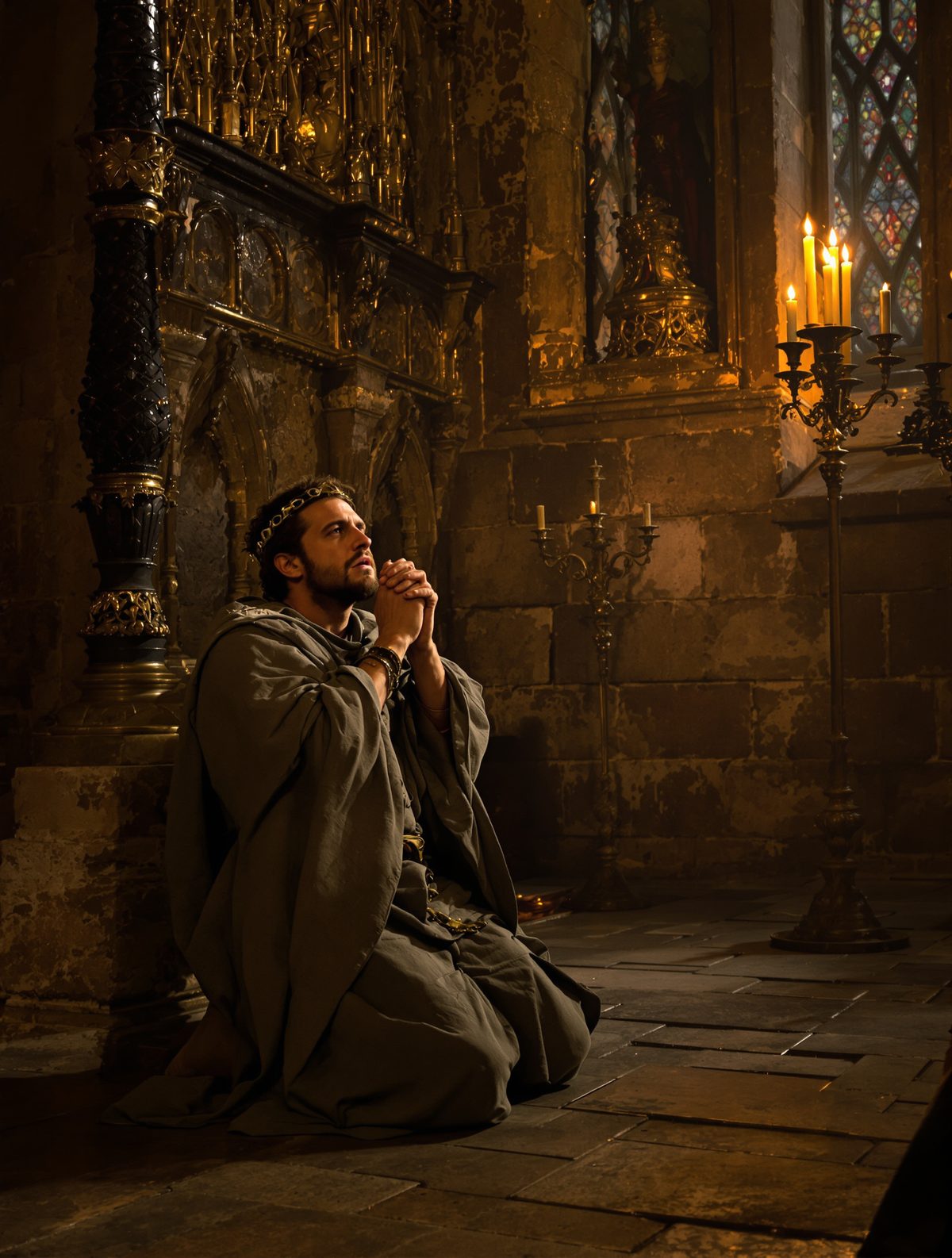
And so, on a sweltering July day in 1174, the king, accompanied by an entourage, embarked on his penitential walk through Canterbury. Witnesses described a king disrobed of majesty, clothed only in a humble sackcloth, treading with bare, bloodied feet over the cobblestones that lined the path to the cathedral — a potent symbol of the penance he sought over Becket’s grave. Reverent silence enveloped the procession; the weight of redemption was palpable.
A Penance That Resounded Across Europe
Upon reaching the soaring edifice of Canterbury Cathedral, Henry prostrated himself before Becket’s tomb. Awaiting him were the attending monks, whose discipline was to administer punishment in the form of scourging — a request made explicit by the king himself. His solemn demeanor spoke volumes, as his whispered prayers for absolution filled the hallowed space within the nave.
The spectacle of Henry's penance was a powerful display and sent ripples throughout medieval Europe. The king’s public act was not only an acknowledgment of guilt but also a savvy political maneuver to ameliorate his stature and appease a populace fervently devoted to the martyred saint. It was a calculated blend of personal contrition and public theater that reflected the interconnected capacities of kingship and faith.
The Aftermath and Legacy
The immediate impact of Henry’s penance was significant. The political and spiritual tides began to turn in his favor. The Church, whose discontent had simmered since Becket’s untimely death, responded favorably to Henry's penitential gesture, thus reinstating a measure of spiritual peace between the crown and church. Pilgrims flocked to Canterbury, adding to its prestige as a sacred site — a sanctity amplified by the reverence shown by the king himself.
Henry II’s barefoot pilgrimage and the subsequent scourging at Becket’s tomb exemplified a king’s readiness to publicly recognize his missteps, a move both deeply personal yet broadly political. It underscored a timeless lesson in leadership: the courage to admit one’s wrongs and the resilience to seek redemption.
A Timeless Tale for the Modern Age
It’s easy, in today’s modern world, to view royalty as removed from contrition, humans perhaps different from us in their perceived infallibility. Yet the humility that Henry II showcased in 1174 is a resounding call to contemporary leaders — royal or otherwise — to remember the virtues of accountability and forgiveness. The spectacle of a mighty king crawling barefoot as an act of penance serves as a reminder that the ultimate strength lies not in infallibility, but in recognizing and amending one's own errors.
As we reflect on the impact of Henry II’s pilgrimage, it underscores the enduring values of humility, redemption, and faith that continue to resonate. The dramatic tableau of a reigning monarch humbling himself before a saint's tomb brings to life the ever-relevant human story of fallibility and atonement, echoing across the centuries to inspire leaders today.