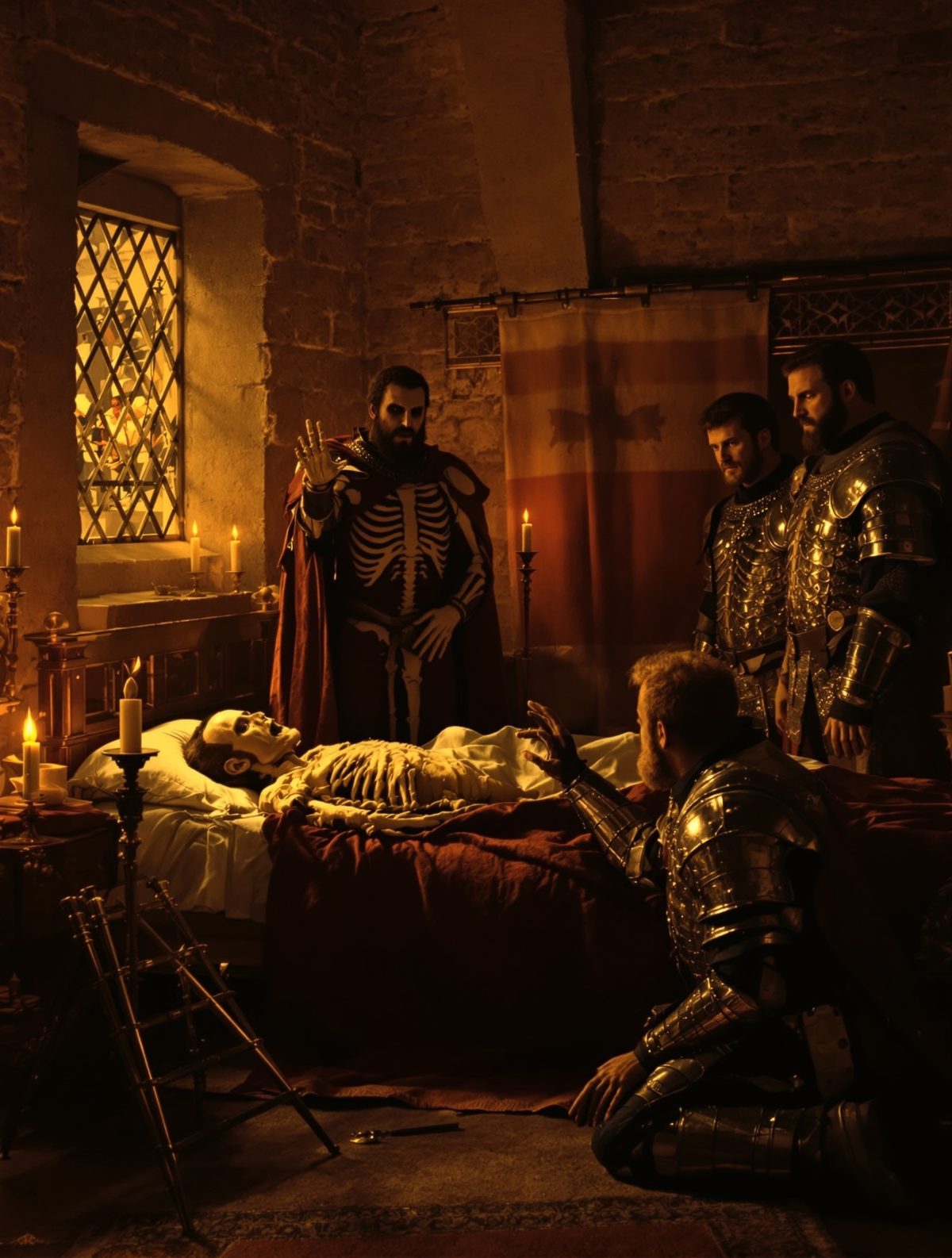
The summer of 1307 found England's most formidable monarch lying on his deathbed in a modest manor house near the Scottish border. King Edward I, the towering figure known as "Longshanks" and the "Hammer of the Scots," was dying far from the splendour of Westminster Palace, his life's final chapter unfolding in the remote village of Burgh by Sands. But it was not the humble setting that would shock those gathered around their sovereign's bedside—it was the extraordinary final command that would echo through the centuries as one of the most macabre royal orders ever issued.
As his courtiers and knights leaned closer to catch the king's weakening words, Edward I delivered an instruction so startling that even these battle-hardened warriors, men who had witnessed the brutality of medieval warfare firsthand, stood speechless. The dying monarch commanded his son and heir to boil the flesh from his bones after death, carry his skeleton north, and bear it before the English army until Scotland was finally, completely conquered.
The Relentless Warrior King
To understand the shocking nature of Edward's deathbed demand, one must appreciate the extraordinary character of this remarkable monarch. Standing six feet two inches tall—a giant by medieval standards—Edward I had spent his entire reign embodying the very essence of medieval kingship through conquest and dominion. His nickname "Longshanks" spoke not only to his impressive physical stature but to his ability to stride across battlefields and strike fear into the hearts of his enemies.
Edward's obsession with Scottish conquest had defined the latter years of his reign. He had already earned his fearsome sobriquet "Hammer of the Scots" through a series of brutal campaigns that had brought much of Scotland under English control. The king had removed the Stone of Destiny from Scone Abbey, installed English garrisons in Scottish castles, and forced Scottish nobles to pay homage to the English crown. Yet despite these victories, Scotland remained restless, rebellious, and unconquered.
By 1307, the sixty-eight-year-old monarch was embarking on what would prove to be his final campaign against the Scots. Robert the Bruce had been crowned King of Scotland the previous year, reigniting Scottish resistance just when Edward believed he had finally subdued the northern kingdom. The English king's fury was legendary—he had reportedly declared that he would not rest until Bruce was captured and Scotland brought to heel once and for all.
The Final Journey North
The royal progress towards Scotland in the early months of 1307 revealed a king whose iron will remained undiminished even as his body began to fail him. Edward's courtiers watched with growing concern as their sovereign, who had always possessed seemingly inexhaustible energy, began to show signs of the illness that would soon claim his life. Yet the king pressed on, driven by an almost supernatural determination to complete his life's work of forging a unified British realm under English dominion.
The royal entourage that accompanied Edward on this final journey was magnificent even by medieval standards. Hundreds of knights, men-at-arms, and courtiers formed a glittering procession that stretched for miles along the dusty roads leading north. Supply trains groaned under the weight of provisions, weapons, and the elaborate trappings of royal ceremony that accompanied the monarch wherever he travelled.
As they approached the Scottish border, however, it became clear that this would be unlike any of Edward's previous campaigns. The king's strength was visibly ebbing, and by the time the royal party reached Burgh by Sands—a small settlement on the northern shores of the Solway Firth—Edward could travel no further. The greatest warrior king of his age was forced to take to his bed, his dream of personally leading one final, decisive assault against Scotland slipping away with each passing hour.
A Command Beyond the Grave
The scene in that modest manor house at Burgh by Sands must have been extraordinary. Here lay one of medieval Europe's most powerful monarchs, surrounded by the cream of English nobility, yet reduced to the same mortal frailty that claims pauper and prince alike. The future Edward II knelt beside his father's bedside, about to inherit not only a crown but also the enormous burden of his father's unfulfilled ambitions.
It was in these final moments that Edward I issued his most shocking royal command. Historical accounts suggest that the dying king, with characteristic determination, ordered his son to have his body boiled after death—a medieval practice that separated flesh from bone, allowing for easier transport of royal remains. But Edward's instructions went far beyond the practical. He commanded that his bones be carried at the head of every English army that marched against Scotland, declaring that his very skeleton would continue the fight for English dominance even after his spirit had departed.
The reaction of those present can only be imagined. These were men accustomed to their sovereign's fierce determination and sometimes brutal methods, yet this command transcended anything they had ever witnessed. The idea that their king intended to wage war from beyond the grave, that his mortal remains should become a perpetual symbol of English aggression against Scotland, left even these hardened warriors struggling to comprehend what they had heard.
Edward II, barely twenty-three years old and about to face the enormous challenge of ruling in his legendary father's shadow, found himself inheriting not just a kingdom but an almost supernatural mandate for conquest. The psychological weight of such a command—that his father's very bones should witness his success or failure as a military leader—must have been overwhelming for the young prince.
The Command Unfulfilled
History records that Edward II ultimately chose not to follow his father's extraordinary final order. Whether from horror at the macabre nature of the command, practical considerations about the difficulties of preserving and transporting skeletal remains, or simply a desire to break free from his father's overwhelming legacy, the new king opted for a more conventional approach to royal burial.
Instead of boiling his father's remains, Edward II arranged for the body to be embalmed and transported south to London with appropriate royal dignity. The great warrior king was eventually interred in Westminster Abbey, where his tomb bears the simple yet powerful Latin inscription "Edwardus Primus Scottorum Malleus hic est" – "Here lies Edward I, Hammer of the Scots." Even in death, the king's identity remained tied to his Scottish obsession, though his bones would never march north as he had commanded.
Some historians have suggested that Edward II's decision to ignore his father's final order may have been one of his first assertions of independence as king. Others argue it demonstrated early signs of the weakness that would later characterise his troubled reign. What seems certain is that the young king recognised the impracticality, if not the impossibility, of fulfilling such an extraordinary royal command.
The story of Edward I's deathbed order offers us a fascinating glimpse into the medieval royal mind, where the boundaries between the sacred and the political, the living and the dead, were far more fluid than in our modern world. It reveals a monarch so consumed with the idea of conquest that he could not bear to let death itself prevent him from achieving his goals. Even today, more than seven centuries later, this remarkable tale reminds us that the British crown has always been occupied by individuals of extraordinary determination—people whose vision extended far beyond their own mortal limitations and who understood that the monarchy itself must transcend any single reign or lifetime.