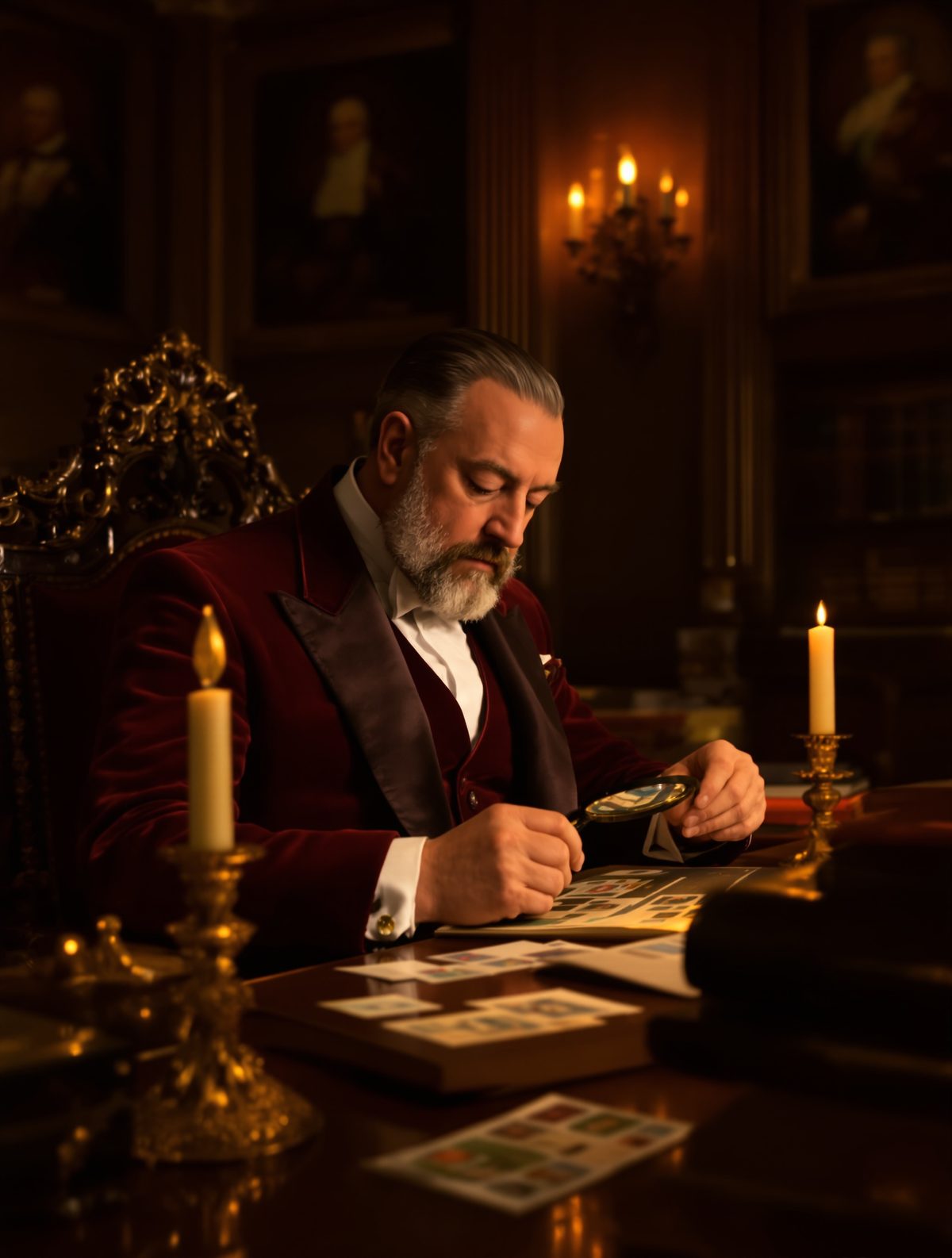
While the Empire slumbered beneath moonlit skies, King George V would slip away from the grand corridors of Buckingham Palace to pursue his most treasured passion. Armed with nothing but flickering candlelight and a well-worn magnifying glass, the sovereign who commanded the loyalty of a quarter of the world's population found his greatest solace in the meticulous arrangement of tiny paper treasures. Night after night, palace servants would discover their monarch fast asleep at his study desk, surrounded by carefully sorted stamps, his magnifying glass still clutched in his weathered hands—a testament to hours spent lost in philatelic reverie.
The Making of a Royal Philatelist
King George V's love affair with stamp collecting began long before he ascended to the throne in 1910. As a young prince, he had been given his first album by his uncle, the Duke of Edinburgh, and what started as a childhood hobby soon blossomed into an all-consuming passion that would define his private hours for the rest of his life. Unlike many royal pursuits that were performed for public consumption or diplomatic necessity, George's philatelic interests represented something deeply personal—a realm where he could exercise complete control and find genuine peace.
The future king's collection grew exponentially during his naval service, when visits to far-flung corners of the Empire provided opportunities to acquire rare and exotic specimens. Each port of call offered new treasures, and George would spend his shore leave hunting through local post offices and markets, building relationships with dealers who would later become lifelong correspondents. By the time he became king, his collection was already considered one of the finest in the world, containing specimens from virtually every British territory and dominion.
Sacred Hours in the Private Study
The king's nightly ritual began after the last state paper had been signed and the final audience concluded. While Queen Mary attended to her own evening pursuits and the palace settled into quiet efficiency, George would make his way to his private study—a sanctuary lined floor to ceiling with specially commissioned albums and filing cabinets. Palace staff quickly learned that these evening hours were inviolate; only the most urgent matters of state could interrupt the sovereign's communion with his stamps.
Working by the warm glow of candles, George would carefully examine new acquisitions through his treasured magnifying glass, a tool that became as much a part of his persona as his naval beard. He would spend hours studying watermarks, perforations, and printing variations with the intensity of a scholar. The king possessed an encyclopedic knowledge of postal history and could identify the provenance and significance of stamps with remarkable precision. His expertise was so renowned that dealers and collectors worldwide sought his opinion on matters of authenticity and rarity.
The physical act of arranging and rearranging his collection seemed to provide George with a meditative calm that the pressures of monarchy rarely allowed. Here, surrounded by these miniature works of art, each representing a different corner of his vast dominions, the king could momentarily set aside the weight of crown and scepter. Palace servants often spoke with affection about discovering their monarch in the early morning hours, having fallen asleep over his albums, completely absorbed in his passion.
A Collection Beyond Compare
What set King George V's collection apart was not merely its size—though it eventually encompassed over 300,000 specimens—but its extraordinary quality and historical significance. The king had access to materials that no ordinary collector could hope to obtain, including proof sheets, printing errors, and stamps that had never entered general circulation. The General Post Office would regularly send him examples of new issues before their official release, and colonial administrators throughout the Empire knew that unusual or rare specimens would find an appreciative home in the royal collection.
George's particular fascination lay with the stamps of the British Empire, and he took special pride in assembling complete runs from each dominion and territory. His collection included the legendary British Guiana 1856 one-cent magenta, numerous Mauritius stamps from the famous 1847 "Post Office" issue, and an unparalleled selection of Indian and Australian rarities. The king also maintained extensive correspondence with stamp dealers and collectors worldwide, demonstrating a depth of technical knowledge that impressed even the most seasoned philatelists.
Beyond the monetary value—though the collection was worth a king's ransom even then—George treasured the historical narrative each stamp represented. To him, these small pieces of paper told the story of his Empire's reach and diversity, from the icy territories of Canada to the tropical islands of the Pacific. Each stamp was a tangible connection to his subjects across the globe, a reminder of the vast realm over which he reigned.
The Human Side of Majesty
Perhaps most remarkably, George's philatelic passion revealed a side of his character that few outside the royal family ever witnessed. Known publicly as a dutiful but somewhat stern figure, the king transformed completely when discussing his collection. Visitors to his study reported a man animated with enthusiasm, eager to share discoveries and discuss the finer points of postal history. His eyes would light up when examining a particularly fine specimen, and he would speak with genuine warmth about the stories behind his most prized pieces.
The king's dedication to his hobby also demonstrated his remarkable capacity for detailed, methodical work. Despite the overwhelming demands of ruling during some of the most turbulent decades in modern history—including World War I, the Russian Revolution, and the Great Depression—George never allowed his collection to be neglected. His nightly sessions with his stamps provided not just entertainment but genuine restoration, a necessary respite that enabled him to face each new day's challenges with renewed energy.
Queen Mary, while not sharing her husband's passion for philately, understood its importance to his well-being and ensured that his study remained undisturbed. The royal children grew up accustomed to their father's nocturnal disappearances and learned to appreciate, if not fully understand, the depth of his commitment to his collection. Prince George (later the Duke of Kent) developed his own interest in philately, though he never matched his father's devotion to the pursuit.
This royal passion for stamps speaks to something beautifully human about monarchy—how even those born to unimaginable privilege and responsibility seek the same simple pleasures that bring joy to ordinary lives. King George V, commanding fleets and armies by day, found his truest contentment in the quiet examination of tiny printed images by candlelight. His midnight ritual reminds us that beneath the crown and ceremony, the human heart seeks beauty, order, and the peaceful satisfaction of pursuing something purely for love. In our digital age, there's something deeply moving about imagining a king finding such profound happiness in these small, tangible treasures—a reminder that the most meaningful royal traditions often happen not in throne rooms or state ceremonies, but in private moments when duty gives way to genuine passion.