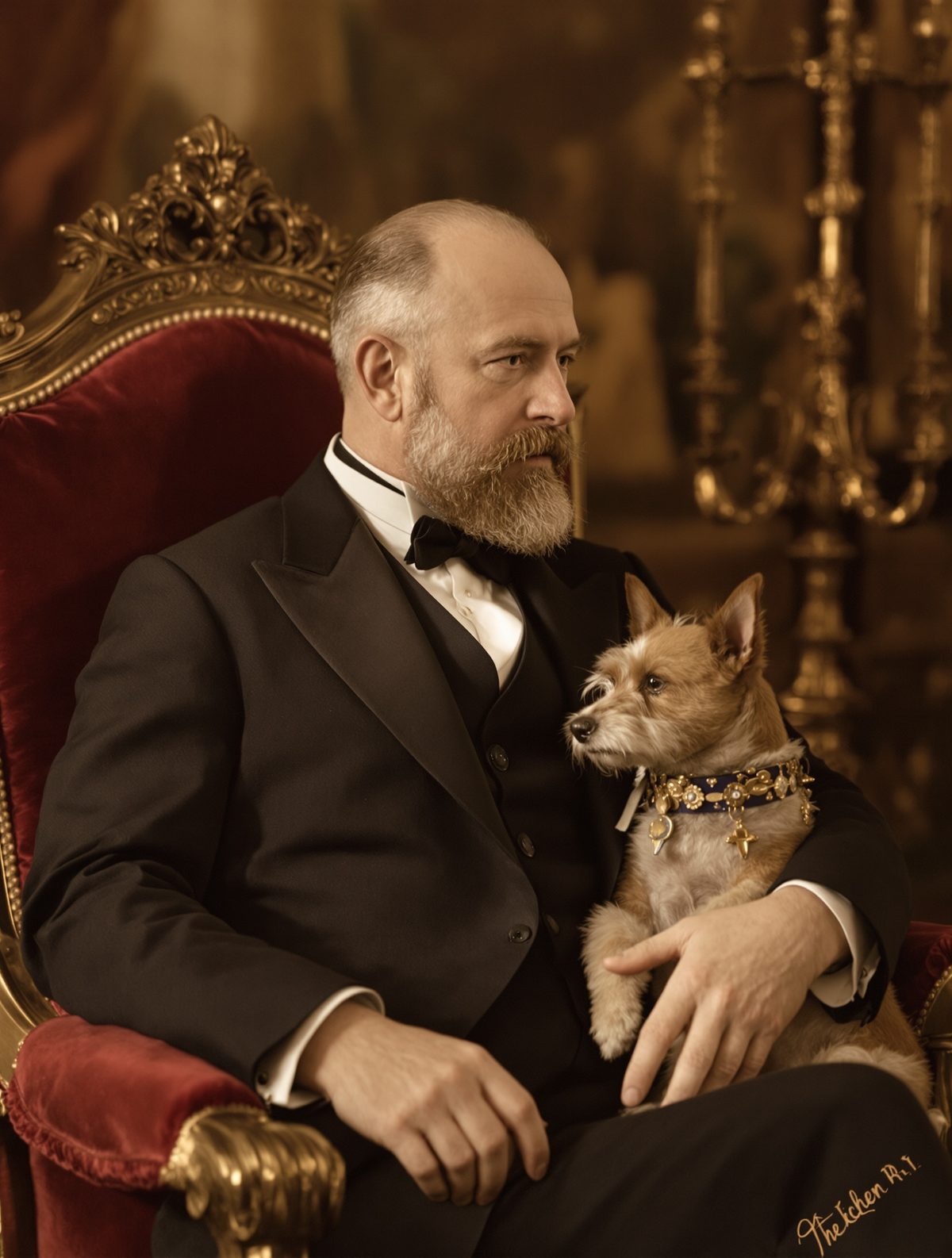
The hushed reverence of Westminster Abbey was shattered by the sound of four tiny paws clicking across ancient stone floors. The Archbishop of Canterbury, Frederick Temple, could hardly believe his eyes as King Edward VII strode confidently toward the altar for his private coronation rehearsal—with a spirited wire fox terrier trotting faithfully at his heels. This was Caesar, the monarch's most devoted companion, and despite every protocol screaming against it, the King had smuggled his beloved dog into Britain's most sacred coronation venue.
What followed was perhaps one of the most charmingly unconventional moments in the long history of British coronations, revealing the deeply human side of a king who refused to let ceremony come between him and his four-legged best friend.
A King's Unlikely Companion
Caesar was no ordinary royal pet. The small, scrappy wire fox terrier had captured King Edward VII's heart completely, becoming his constant shadow throughout the corridors of Buckingham Palace, Sandringham, and beyond. Unlike the formal spaniels and retrievers traditionally favoured by British royalty, Caesar possessed an independent spirit and mischievous charm that perfectly matched his royal master's own larger-than-life personality.
The bond between Edward and Caesar was extraordinary, even by royal standards. Palace staff became accustomed to seeing the little dog perched on silk cushions during state meetings, wandering freely through drawing rooms where foreign dignitaries gathered, and enjoying privileges that would have made many courtiers envious. Edward, who had waited decades to inherit the throne from his long-lived mother Queen Victoria, found in Caesar a loyal companion who offered unconditional devotion without the complexities of court politics.
The terrier's elevated status was evident in every aspect of his daily life. He wore a collar that proclaimed "I am Caesar. I belong to the King," leaving no doubt about his important position in the royal household. Palace servants were instructed to treat Caesar with the same respect they would show any member of the royal family, and the dog quickly learned to expect—and receive—treatment befitting his exalted station.
Sacred Rehearsals and Secular Scandals
The coronation of 1902 was particularly significant, marking not just Edward's ascension to the throne after Victoria's 63-year reign, but also the dawn of a new century and a new era for the British monarchy. Every detail had to be perfect, from the precise timing of the ancient rituals to the coordination of hundreds of peers, clergy, and officials who would participate in the sacred ceremony.
Private rehearsals in Westminster Abbey were considered among the most solemn and secret preparations for the coronation. These sessions allowed the King to practice the complex choreography of the service, from the precise moment he would enter the Abbey to his positioning during the anointing and crowning. The Archbishop of Canterbury took these rehearsals with utmost seriousness, viewing them as sacred dress rehearsals for one of Christianity's most ancient and meaningful ceremonies.
The sight of Caesar padding confidently down the aisle, investigating the coronation chair, and settling himself comfortably near the altar undoubtedly challenged every notion of proper ecclesiastical protocol. Yet Edward's determination to include his faithful companion revealed something profound about his character—a king who understood the importance of ceremony but refused to abandon the relationships that brought him genuine comfort and joy.
Palace records suggest that Archbishop Temple initially attempted to persuade the King to leave Caesar outside during rehearsals, but Edward's response was characteristically firm. His attachment to the little terrier was not mere whim but genuine affection, and he saw no reason why his beloved companion should be excluded from any aspect of his royal duties, including preparation for his coronation.
The Human Side of Majesty
Edward's insistence on including Caesar in his coronation preparations illuminates a fascinating aspect of his reign and personality. Unlike his mother Victoria, who maintained an austere and distant public image for much of her later reign, Edward brought warmth, humor, and distinctly human touches to the monarchy. His relationship with Caesar exemplified this approach—he was a king who understood that genuine affection and loyalty, whether from subjects or pets, formed the true foundation of successful leadership.
The King's devotion to Caesar also reflected his broader approach to modernizing the monarchy for the twentieth century. While maintaining the dignity and tradition essential to the crown, Edward sought to make the royal family more accessible and relatable to ordinary British subjects. His obvious love for his little dog resonated with countless families across the kingdom who cherished their own beloved pets.
Caesar's presence during the rehearsals likely provided Edward with much-needed emotional support during what must have been an overwhelming time. After decades as Prince of Wales, the new King was finally preparing for the moment he had long awaited. Having his trusted companion nearby would have offered reassurance and a touch of normalcy amid the extraordinary circumstances surrounding his coronation preparations.
The little terrier's behavior during these sacred rehearsals apparently demonstrated remarkable intelligence and sensitivity. Rather than disrupting the proceedings, Caesar seemed to understand the solemnity of the occasion, remaining quiet and attentive while his master practiced the ancient rituals that would soon make him the anointed King-Emperor.
Legacy of Loyalty and Love
The story of Caesar's attendance at the coronation rehearsals became part of Edward VII's endearing legend, cementing his reputation as a monarch who never lost touch with simple human pleasures and genuine emotional connections. The King's willingness to challenge protocol for the sake of his beloved pet demonstrated the kind of authenticity that would characterize his entire reign.
Caesar remained Edward's devoted companion until the King's death in 1910, and the little dog's grief was reportedly visible to all who witnessed the funeral procession. The terrier walked behind Edward's coffin during the funeral, a final tribute to their extraordinary bond and a touching reminder that even kings need the unconditional love that only a faithful pet can provide.
This charming episode from 1902 reminds us that behind the crowns, ceremonies, and constitutional duties, the monarchy has always been comprised of individuals with deeply human needs for companionship, comfort, and unconditional love. Edward VII's determination to include Caesar in his most important rehearsals reveals a king who understood that true strength comes not from rigid adherence to protocol, but from surrounding oneself with those who offer genuine devotion. In an age when the British royal family continues to navigate the balance between tradition and authenticity, the image of a small wire fox terrier padding confidently through Westminster Abbey serves as a delightful reminder that the most memorable royal moments often arise when humanity triumphs over ceremony.