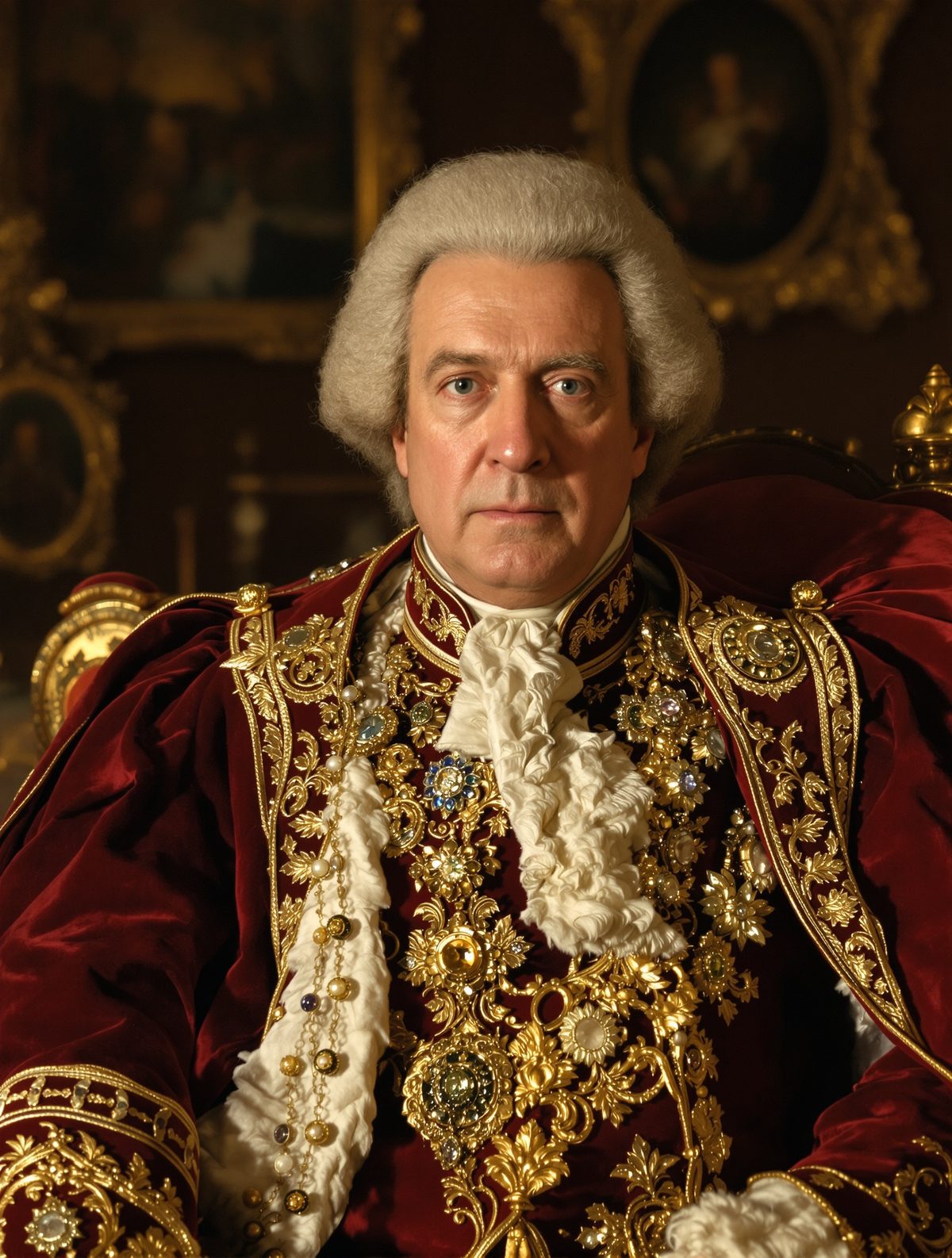
On a crisp autumn morning in 1760, King George II began what seemed like an ordinary day at Kensington Palace. The 76-year-old monarch rose early, as was his custom, unaware that within minutes, the House of Hanover would face its most tragic and undignified moment in the most private room of the palace. What followed would become one of the most poignant stories in British royal history—a tale that speaks not of grand battles or political triumphs, but of the simple, vulnerable humanity that lies beneath every crown.
A Monarch's Final Morning
October 25th, 1760, dawned like countless other mornings during George II's 33-year reign. The King, despite his advanced age, maintained the disciplined routine that had characterized his entire life. Rising early at Kensington Palace, he went about his private morning rituals with the same methodical precision that had governed his approach to kingship.
George II had always been a creature of habit. Those who knew him well—his valets, courtiers, and household staff—could set their clocks by his daily routines. He was a king who found comfort in order and predictability, perhaps stemming from the tumultuous early years of Hanoverian rule in Britain, when his father George I had struggled to establish the dynasty's legitimacy on these shores.
The palace was stirring to life around him as servants began their daily duties. Kensington Palace, though not as grand as some royal residences, held special significance for George II. It was where he had spent much of his childhood, and where he felt most at home. The familiar corridors and chambers provided a sense of continuity that had sustained him through decades of rule.
The Moment That Changed Everything
What happened next unfolded in a matter of moments, yet its impact would resonate through royal history. The King's valet, going about his own morning duties, heard a sudden, loud crash emanating from the royal water closet. The sound was so unexpected and alarming that it immediately drew attention throughout that wing of the palace.
When the crash was followed by an ominous silence, the valet knew something was terribly wrong. Protocol demanded a delicate balance between respecting royal privacy and ensuring the monarch's safety. After what must have seemed like an eternity of waiting and listening, the decision was made to investigate.
What they discovered was devastating: King George II had collapsed, having suffered what we now know was a massive heart attack. The sovereign who had led Britain through wars, political upheavals, and decades of social change had died alone, in the most private and vulnerable of circumstances.
The medical understanding of the 18th century was limited, but court physicians later determined that the King had likely experienced a sudden, catastrophic cardiac event. At 76, George II had lived well beyond the average lifespan of his era, but his final moments revealed the stark reality that death comes to all, regardless of rank or title.
The Human Story Behind the Crown
To understand the true pathos of this moment, we must look beyond the circumstances of George II's death to the life of the man himself. This was a monarch who had lived through extraordinary times—he was the last British king to personally lead troops into battle, at Dettingen in 1743. He had weathered political storms, family dramas, and the constant pressures of maintaining Hanoverian authority in a still-suspicious Britain.
George II's personal life had been marked by both deep affection and profound loss. His marriage to Caroline of Ansbach had been one of genuine love and intellectual partnership—a rarity among royal unions of the era. Caroline's death in 1737 had left him heartbroken, and though he had relationships afterward, he never fully recovered from losing his beloved queen. "I never yet saw a woman fit to buckle her shoe," he reportedly said of other women after Caroline's passing.
The King had also endured the complex dynamics of Georgian royal family life, including a notoriously difficult relationship with his son Frederick, Prince of Wales, who had died unexpectedly in 1751. These personal losses had taken their toll, leaving George II increasingly isolated in his later years, despite being surrounded by the grandeur of court life.
Perhaps most heartbreaking is the realization that this monarch, who had spent his entire adult life surrounded by people, died utterly alone. No loving hand held his, no familiar voice offered comfort, no family member was present to ease his passage from this world. It was a solitary end that seems to underscore the fundamental loneliness that can accompany even the most exalted positions.
A Palace in Crisis
The discovery of the King's death sent immediate shockwaves through Kensington Palace. In an era when royal protocol governed every aspect of court life, the undignified circumstances of the monarch's passing created unprecedented challenges. How does one announce that the King has died in such circumstances? How does one maintain the dignity of the crown while acknowledging the stark humanity of the moment?
The palace machinery swung into action with remarkable efficiency, testament to the well-oiled system that surrounded royal life. Messages were dispatched with utmost urgency to locate the heir—George II's grandson, the future George III, who was 22 years old and hunting in the countryside, blissfully unaware that he was about to become king.
The court physicians were summoned to examine the King and provide an official cause of death. The delicate task of preparing the royal body while maintaining appropriate dignity fell to trusted servants who had served George II faithfully for years. These individuals, whose names history has largely forgotten, showed remarkable devotion in ensuring their master's final dignity.
Word of the King's death gradually spread through the palace, then to London, and eventually across the empire. The official announcements, naturally, made no mention of the specific circumstances, referring simply to the King's sudden passing at Kensington Palace. Royal protocol demanded that the crown's dignity be preserved, even in death.
Legacy of a Life Cut Short by Time
George II's death marked the end of an era in more ways than one. He had been the last link to the early days of Hanoverian rule, the final monarch to remember the uncertainties and challenges of establishing a foreign dynasty on the British throne. His passing paved the way for his grandson George III, who would rule for 60 years and preside over the loss of the American colonies, among other momentous events.
The manner of George II's death, while undignified, paradoxically serves to humanize a figure who might otherwise seem remote to modern audiences. In an age when monarchs were often viewed as divinely appointed and somehow above ordinary human concerns, this stark reminder of mortality brings George II closer to us across the centuries.
His reign had seen Britain emerge as a major European power, with victories in conflicts from Europe to North America. The cultural flowering of the Georgian era—from Handel's music to the architectural achievements that still grace London today—had begun under his rule. Yet perhaps his most enduring legacy is this very human reminder that greatness and vulnerability can coexist in the same person.
Today, as we observe the British monarchy continuing its ancient traditions while adapting to modern times, George II's story offers a poignant reminder of the personal costs of royal duty. Every monarch, from the most glorious to the most humble, carries the burden of representing something larger than themselves, often at great personal sacrifice. In the end, George II's death speaks not to the weakness of kings, but to the strength required to bear a crown throughout an entire lifetime—right up to the very final, solitary moment.