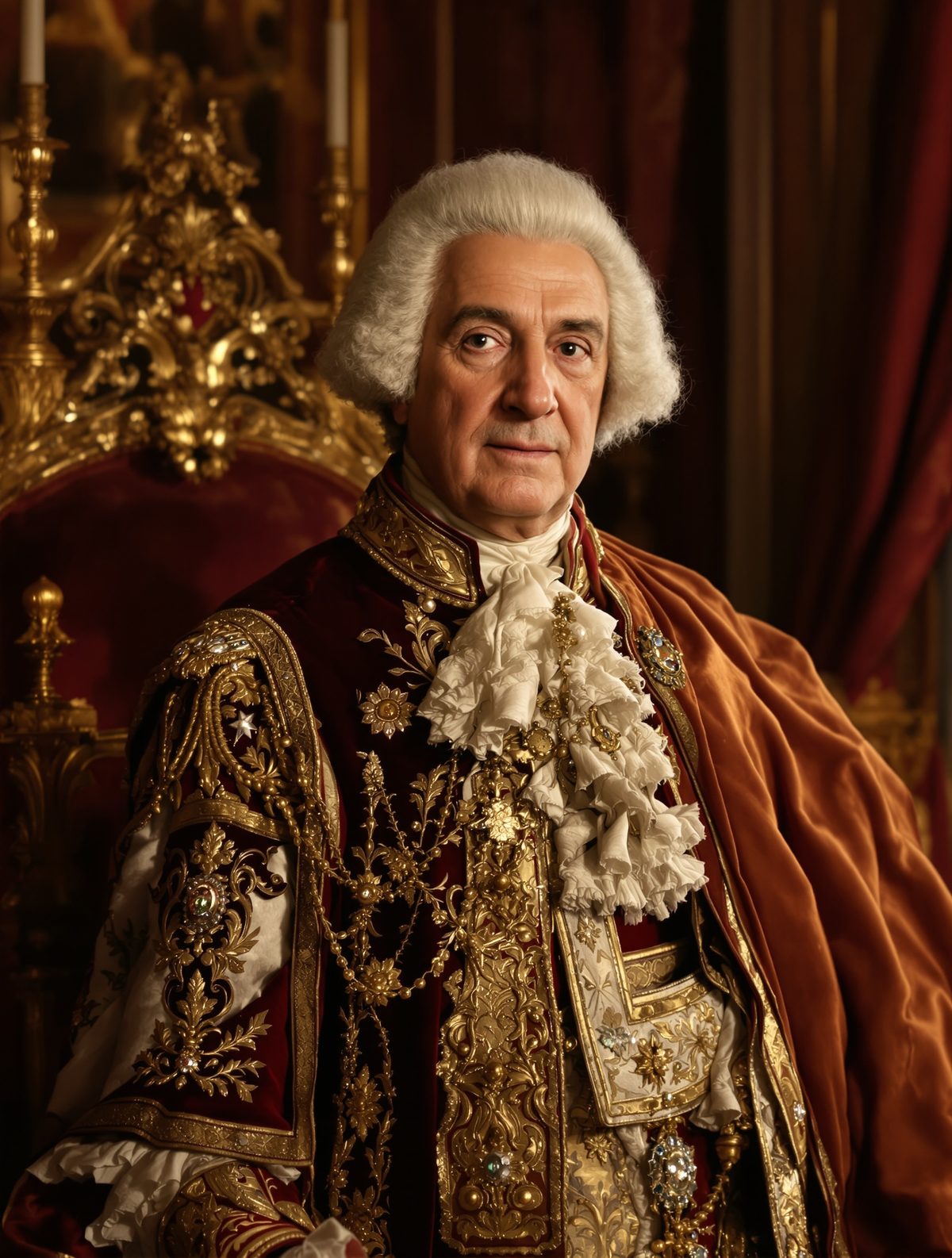
On the crisp autumn morning of October 25th, 1760, King George II rose from his bed at Kensington Palace with no inkling that history would remember this day not for any royal decree or state occasion, but for the most undignified end any British monarch has ever faced. The man who had ruled for thirty-three years, commanded armies, and shaped an empire was about to meet his maker in the most private and embarrassing circumstances imaginable.
When his faithful German valet arrived with the King's customary morning chocolate and found His Majesty absent from his chambers, a search began that would uncover one of the most startling scenes in royal history. The seventy-six-year-old sovereign lay collapsed on the floor of his water closet, having suffered what physicians would later determine was likely a massive heart attack or stroke. The King of Great Britain had died alone, in complete privacy, while attending to the most basic of human needs.
A Morning Like Any Other at Kensington Palace
George II had always been a creature of rigid habit, and October 25th began no differently from countless mornings before. The King maintained a precise routine at Kensington Palace, his preferred London residence, which had served as a royal home since William III first acquired it in 1689. Rising early, as was his custom throughout his long reign, George II would typically dress with the assistance of his German valets—men he trusted implicitly and who had served him for decades.
The palace itself buzzed with the controlled activity of a well-ordered royal household. Servants moved through the State Apartments and private quarters with practiced efficiency, preparing for another day in service to the Crown. The King's chocolate—a luxury that had become fashionable among European royalty—was prepared according to his exact specifications, a small but important ritual that marked the beginning of each royal day.
But on this particular morning, when the valet arrived at the King's private apartments, he found them eerily quiet. The King's bed showed signs of occupancy, but His Majesty was nowhere to be seen. In an age when royal protocol dictated that monarchs were rarely, if ever, left completely alone, this absence was both unusual and concerning.
The Grim Discovery
After searching the immediate chambers without success, the valet's concern grew into alarm. Palace etiquette demanded discretion, but the welfare of the sovereign took precedence over all other considerations. Following the sounds of what may have been a fall or disturbance, the search led to the King's private water closet—a room that, despite its humble function, would have been appointed with the finest fixtures available to Georgian royalty.
What the valet discovered there would become one of the most whispered-about moments in royal history. King George II lay motionless on the floor, having apparently suffered a sudden and catastrophic medical event. The man who had led Britain through the War of Austrian Succession, overseen the expansion of the empire, and maintained the Hanoverian dynasty's hold on the British throne had breathed his last in complete solitude.
The exact length of time the King lay undiscovered remains uncertain, but historical accounts suggest it may have been several hours. In an era before modern medical understanding, the symptoms that might have warned of an impending heart attack or stroke would have gone unrecognized. George II, despite his advanced age, had maintained an active lifestyle and showed few signs of the cardiovascular disease that likely claimed his life.
A King Defined by Duty and Determination
To understand the poignancy of George II's final moments, one must appreciate the man he had been throughout his remarkable reign. Born in Hanover in 1683, he had ascended to the British throne in 1727 upon his father George I's death, inheriting a kingdom that was still adjusting to the relatively new Hanoverian dynasty.
George II proved himself to be a conscientious and dedicated monarch, deeply committed to his adopted country despite his German origins. He was the last British king to personally lead his troops into battle, fighting courageously at Dettingen in 1743 during the War of Austrian Succession. His reign saw significant expansion of British influence overseas, including major victories in the Seven Years' War that helped establish Britain as a dominant global power.
The King was known for his explosive temper but also for his unwavering sense of duty. He took his responsibilities seriously, working closely with prime ministers like Sir Robert Walpole and the Elder Pitt to navigate the complex political challenges of the eighteenth century. His marriage to Caroline of Ansbach was genuinely affectionate, and her death in 1737 left him genuinely bereft—he never remarried, honoring his promise to her that he would only take mistresses.
Despite his sometimes difficult personality, George II commanded respect for his dedication to Britain and his genuine efforts to understand and serve his subjects' interests.
The Immediate Aftermath and Royal Succession
Once the shocking discovery was made, Kensington Palace erupted into carefully controlled activity. The news of the King's death had to be managed with the utmost discretion and protocol. Court physicians were summoned to confirm what was already tragically apparent, while senior palace officials began the complex process of notifying the government and preparing for the immediate succession.
The crown passed automatically to George II's twenty-two-year-old grandson, who would reign as George III. The young man who would go on to rule for sixty years—including through the American Revolution and the Napoleonic Wars—learned of his accession in circumstances that perfectly illustrated the unpredictable nature of royal destiny. One moment he was a prince enjoying a relatively carefree existence; the next, he bore the full weight of the British Crown.
Palace officials faced the delicate challenge of announcing the King's death without dwelling on the embarrassing circumstances. Official proclamations focused on the peaceful nature of his passing and his decades of faithful service to the realm. The more undignified details were carefully omitted from public statements, though they inevitably became part of the whispered folklore of the Georgian court.
A Very Human End to a Royal Life
The manner of George II's death, while undignifiedly memorable, serves as a powerful reminder that monarchy, for all its pomp and ceremony, cannot shield its holders from the fundamental realities of human existence. Even kings must face mortality, and sometimes that meeting occurs in the most ordinary and private of circumstances.
There is something oddly democratic about George II's final moments—a leveling reminder that beneath the crown jewels and royal robes, monarchs share the same basic human experiences as their subjects. The King who had commanded armies and shaped international policy met his end in a way that was utterly, completely human.
This incident also highlights the isolated nature of royal life, even in death. The fact that the King lay undiscovered for hours speaks to the formal distances that surrounded monarchy, even in private moments. It was a loneliness that many of his successors would recognize, the peculiar isolation that comes with supreme power and position.
Today, as we watch our current Royal Family navigate the challenges of modern monarchy, George II's story reminds us that behind every crown lies a person susceptible to all the vulnerabilities of human existence. His undignified end paradoxically humanizes a man who spent his life elevated above ordinary mortals, offering us a glimpse of the fundamental humanity that connects all generations of the royal story—from the Georgian court to the House of Windsor today.