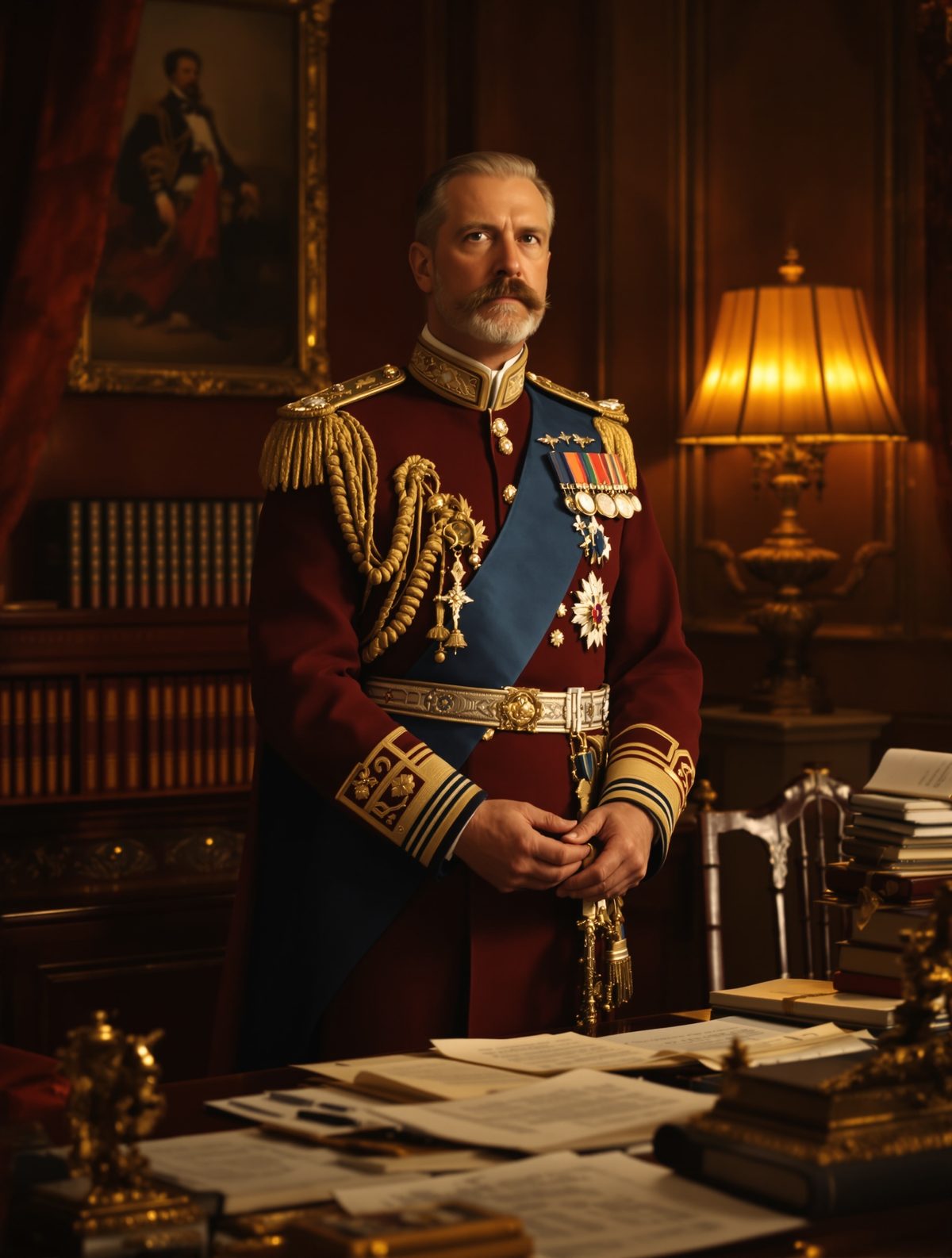
In the dead of night on July 17, 1917, clerks worked frantically throughout Buckingham Palace, Windsor Castle, and government offices across Britain. Armed with official seals and fresh ink, they were systematically erasing a royal legacy that stretched back generations. By dawn, one of the most Germanic dynasties in European history had vanished from British records forever. King George V had orchestrated one of the most audacious rebranding exercises in royal history—and hardly anyone noticed it happening.
A German Dynasty on the British Throne
To understand the magnitude of George V's decision, we must first appreciate just how thoroughly German the British Royal Family had become. When Queen Victoria married Prince Albert of Saxe-Coburg and Gotha in 1840, she wasn't merely taking a husband—she was binding the British crown to one of Germany's most prominent royal houses. Their son, the future Edward VII, inherited his father's Germanic surname, and when Edward's son George ascended the throne in 1910, he ruled as King George V of the House of Saxe-Coburg-Gotha.
The irony was not lost on contemporary observers. Here was a royal family whose members spoke German at family gatherings, maintained close relationships with German cousins (including Kaiser Wilhelm II), and whose very name proclaimed their Teutonic heritage. Yet they ruled over an empire upon which, famously, the sun never set. For decades, this cultural duality had been a source of fascination rather than concern. The British public had grown accustomed to their cosmopolitan monarchy, and Victoria's German connections had even been seen as diplomatically advantageous.
But 1917 was not a year for diplomatic nuance. As the Great War raged into its third devastating year, anything German had become deeply suspect in Britain. German shops were vandalized, dachshunds were kicked in the streets, and even German music was banned from concert halls. The Royal Family found themselves in an increasingly uncomfortable position, their Germanic surname a daily reminder of their blood ties to the enemy.
The Pressure Mounts
The breaking point came in the spring of 1917, when German aircraft began bombing London with terrifying regularity. These weren't the distant battles of the Somme or Passchendaele—this was warfare brought directly to British soil, to the streets where ordinary citizens lived and worked. As Londoners huddled in Underground stations during air raids, some began to ask uncomfortable questions about their King's loyalty.
The situation became even more delicate when H.G. Wells, the celebrated author, publicly criticized what he called "an alien and uninspiring court." Though Wells later clarified his remarks, the damage was done. Here was one of Britain's most respected intellectuals questioning the royal family's British credentials. Palace courtiers reported that George V was deeply wounded by such suggestions, but more importantly, he recognized the very real danger they represented to the monarchy's future.
Adding to the pressure was the revolution in Russia, where George V's cousin, Tsar Nicholas II, had been forced to abdicate in March 1917. The fall of the Romanovs sent shockwaves through every royal house in Europe. Suddenly, the divine right of kings seemed far from guaranteed. George V understood that survival in this new world would require adaptation—and sacrifice.
The Secret Transformation
What happened next was a masterclass in royal crisis management. Rather than defend his German heritage or attempt to explain the complexities of royal genealogy to an increasingly hostile public, George V chose to sever those ties completely. But this wasn't merely a symbolic gesture—it was a comprehensive rewriting of royal identity.
Working closely with his private secretary, Lord Stamfordham, the King devised a plan that was both elegant and radical. They would adopt an entirely new royal surname, one that was unquestionably English and carried deep historical resonance. After considering several options, they settled on Windsor—a name that evoked not only the ancient castle that had housed monarchs for nearly a thousand years, but also the very essence of English permanence and tradition.
The official proclamation, issued on July 17, 1917, was remarkable in its scope. Not only did it establish the new House of Windsor, but it also stripped German titles from all members of the Royal Family and their relatives living in Britain. German princes became English dukes overnight. The King's own first cousins saw their titles changed from exotic Germanic designations to familiar English peerages. Prince Louis of Battenberg became the Marquess of Milford Haven, while the Duke of Teck was rechristened the Marquess of Cambridge.
More Than Just a Name Change
What makes this transformation so fascinating is how thoroughly it was executed. This wasn't simply a matter of printing new letterhead—it was a complete reimagining of royal identity. Palace staff were instructed to remove or replace Germanic decorative elements throughout the royal residences. Portraits of German relatives were quietly relocated to less prominent positions. Even the royal collection of German music was discretely archived.
Perhaps most remarkably, the change was presented not as a retreat from German heritage, but as a return to authentic British roots. Palace communications emphasized that Windsor was the King's ancestral home, that this was where his heart had always truly belonged. The narrative was so skillfully crafted that many Britons came to believe the Royal Family had always been the House of Windsor.
The King's German cousin, Kaiser Wilhelm II, reportedly responded to the news with characteristic sarcasm, joking that he looked forward to attending a performance of "The Merry Wives of Saxe-Coburg-Gotha." But his mockery only highlighted how completely George V had outmaneuvered his critics. By abandoning his Germanic identity so decisively, the King had transformed a potential weakness into a demonstration of patriotic commitment.
A Legacy That Endures
The success of George V's strategy can be measured not just in its immediate impact, but in its lasting legacy. The House of Windsor survived the remaining years of the Great War, the upheavals of the 1920s and 1930s, the Second World War, and continues to thrive in the 21st century. More than a century later, it's almost impossible to imagine the British Royal Family by any other name.
When we watch King Charles III carry out his royal duties, or see the Prince and Princess of Wales representing the crown at state occasions, we're witnessing the continuation of an identity forged in that moment of crisis in 1917. The Windsor name has become so synonymous with British royalty that its Germanic origins feel like ancient history—exactly as George V intended.
The transformation also demonstrated a crucial truth about the monarchy's survival instincts. Rather than clinging rigidly to tradition when circumstances demanded change, George V showed that the crown could adapt while maintaining its essential dignity and authority. This flexibility—this willingness to evolve when necessary—may be one of the key reasons why the British monarchy has endured when so many of its European counterparts have fallen.
In our current age of rapid global change and shifting national identities, George V's bold decision offers a fascinating glimpse into the delicate balance between tradition and adaptation that defines successful institutions. Sometimes, preserving the essence of something precious requires the courage to change everything else—even if that change must happen under cover of darkness, completed before the world awakens to witness the transformation.