
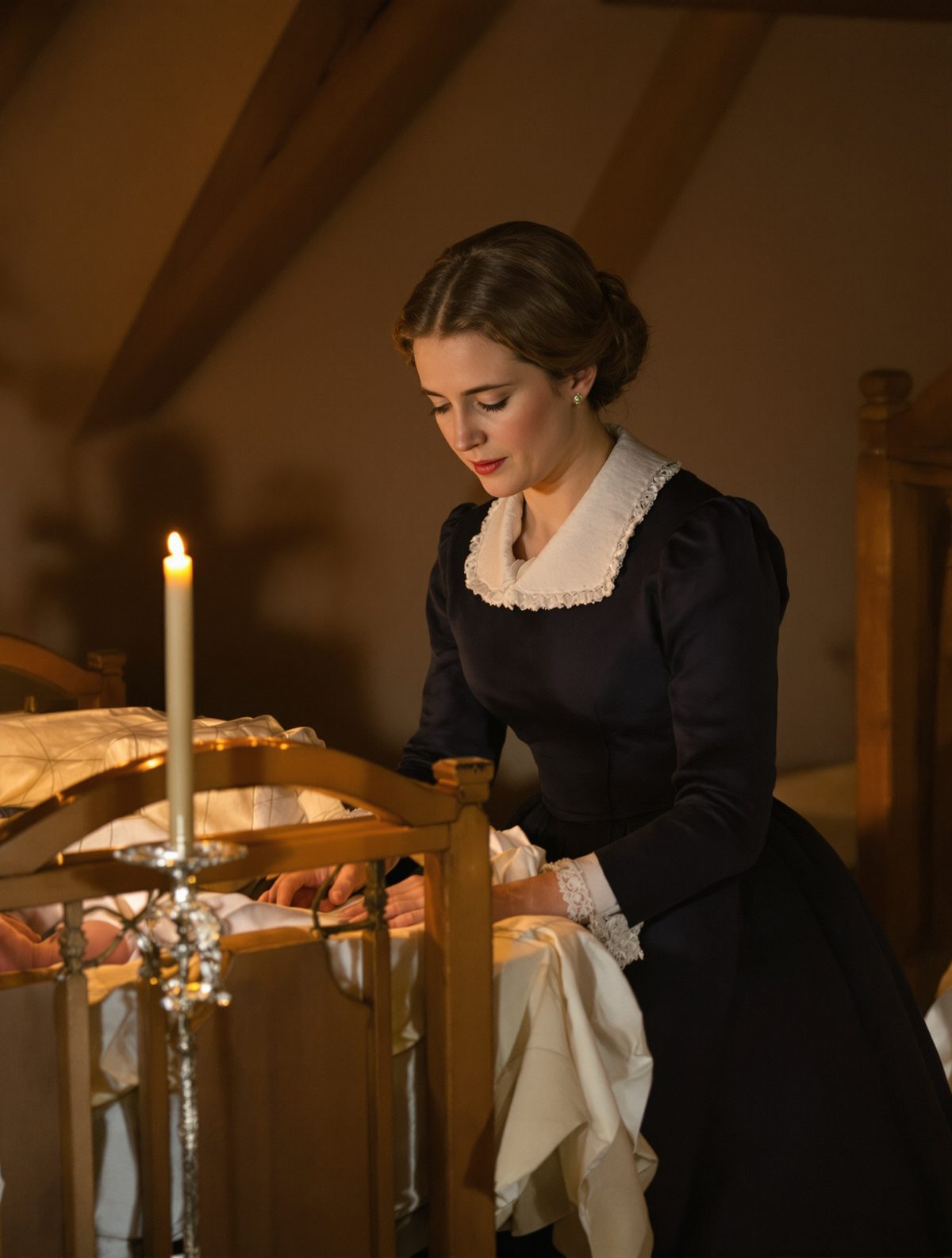
In the shadow of Prince Albert's tragic death in 1861, the British Royal Family retreated into deep mourning. While Queen Victoria draped herself in black and withdrew from public life, her daughter Princess Alice was quietly embarking on a journey that would shock the royal establishment to its core. Far from the watchful eyes of the British court, in the German duchy of Hesse-Darmstadt, Alice was rolling up her sleeves and learning skills no princess had ever dared to master.
A Princess Transformed by Grief
Princess Alice's transformation from sheltered royal daughter to hands-on caregiver began during her father's final illness. As Prince Albert lay dying at Windsor Castle, it was Alice who remained steadfastly by his bedside, tending to his needs with a devotion that moved everyone who witnessed it. The experience of caring for her beloved father awakened something profound within the 18-year-old princess—a calling that would define the rest of her remarkable life.
After Prince Albert's death, Alice married Prince Louis of Hesse in 1862, a subdued ceremony that reflected the court's deep mourning. Moving to Darmstadt marked the beginning of Alice's independence from her mother's overwhelming grief and rigid expectations. In her new home, surrounded by the challenges of German court life and the needs of ordinary people, Alice discovered her true vocation.
The princess began by visiting the sick and poor in Darmstadt, but soon realized that her sheltered upbringing had left her woefully unprepared for the realities of suffering she encountered. Rather than retreat to the safety of royal protocol, Alice made the extraordinary decision to educate herself properly. She sought out medical knowledge, studying anatomy, disease, and most scandalously of all, the art of midwifery.
The Secret Education of a Royal Midwife
Alice's medical education was conducted with utmost secrecy. In an era when even upper-class ladies were expected to remain ignorant of bodily functions, the idea of a princess studying childbirth was revolutionary. Alice worked with local physicians and midwives, learning not just theory but practical skills. She studied the mechanics of birth, the signs of complications, and the delicate art of bringing new life safely into the world.
The princess's dedication was remarkable. She would slip away from court functions to attend births, arriving at humble cottages in simple dress, her royal jewels replaced by practical clothing suitable for the birthing chamber. Local women, initially startled to find a princess at their bedside, soon came to trust Alice's gentle competence and genuine care.
Alice's approach was revolutionary for its time. She believed in cleanliness when many medical practitioners still dismissed handwashing as unnecessary. She insisted on proper sanitation and fought against the acceptance of high maternal mortality as inevitable. Her royal status, rather than being a hindrance, became a powerful tool for promoting better medical practices throughout the region.
Queen Victoria's Horror and Outrage
When news of Alice's activities eventually reached Queen Victoria, the reaction was explosive. The Queen, already struggling with her own grief and the burden of ruling alone, was appalled to learn that her daughter was involving herself in what she considered the most unseemly aspects of life. In Victoria's view, royal ladies should concern themselves with charitable works at a respectable distance—not with the intimate and decidedly unroyal business of childbirth.
The Queen's letters to Alice during this period reveal her genuine distress at what she saw as a betrayal of royal dignity. Victoria had always maintained strict ideas about appropriate behavior for royal women, and Alice's hands-on approach to medicine violated every principle the Queen held dear about feminine propriety and royal protocol.
The royal establishment was scandalized. Court officials whispered about the unseemly spectacle of a princess attending births like a common midwife, concerned that such behavior would undermine the mystique and dignity of the monarchy itself.
But Alice refused to be cowed by her mother's disapproval or the court's shock. She declared her medical work to be a sacred duty, arguing that her privileged position came with an obligation to serve those less fortunate. This wasn't mere charity work conducted from a comfortable distance—it was active, practical service that put her directly in touch with human suffering and joy.
A Sacred Duty Defended
Alice's defense of her work revealed a depth of character that surprised even those who knew her well. She argued that true Christian service required more than token gestures of charity. Her royal birth, she maintained, gave her unique opportunities to make a real difference in people's lives, and she was determined to use those opportunities fully.
The princess's work extended far beyond individual births. She established training programs for local midwives, promoted better hygiene practices, and used her influence to improve medical facilities throughout Hesse-Darmstadt. Her efforts contributed to a measurable decrease in maternal and infant mortality in the region—a legacy that would outlast any royal scandal.
Alice's commitment to her medical work continued throughout her life, even as she faced personal tragedies including the loss of her own children. She would later apply her skills during the Austro-Prussian War, tending to wounded soldiers with the same dedication she had shown to laboring mothers. Her approach to royal duty was fundamentally different from her mother's—less ceremonial, more hands-on, and deeply practical.
A Legacy That Transcends Scandal
Looking back at Princess Alice's extraordinary commitment to midwifery, we see a royal who was far ahead of her time. Her insistence that privilege comes with genuine responsibility, not just ceremonial duties, prefigured the modern royal family's emphasis on charitable work and public service. In many ways, Alice's approach to royal duty was more radical than anything we see today—she didn't just lend her name and presence to causes, she rolled up her sleeves and did the work herself.
Her story reminds us that the most meaningful royal service often happens away from the cameras and ceremonies. While Queen Victoria's shock was understandable given the social conventions of her time, Alice's courage in following her convictions established a template for purposeful royal life that continues to inspire. In our modern world, where we value authenticity and genuine engagement, Princess Alice's determination to serve with her hands as well as her heart seems not scandalous, but exemplary.