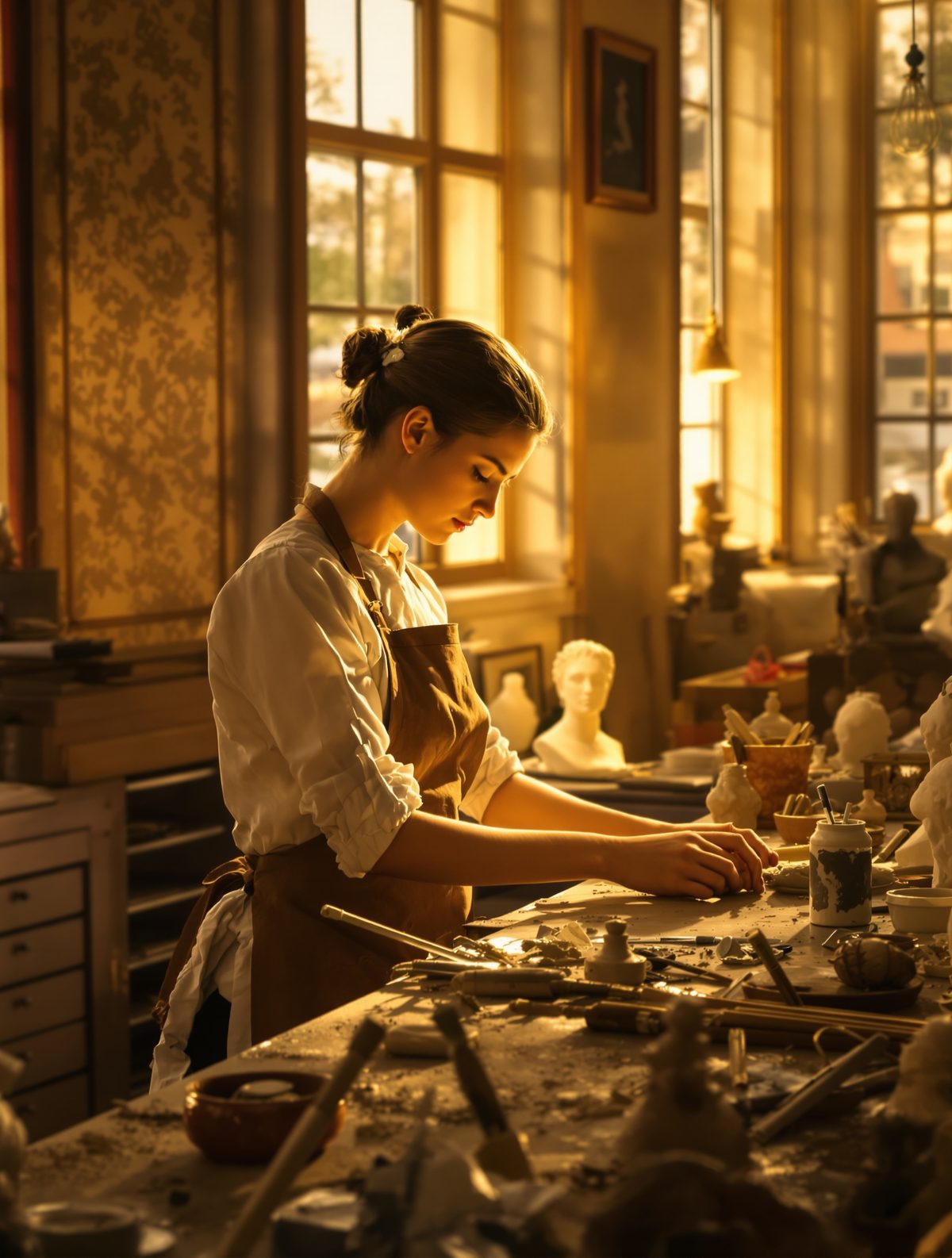
In the grimy, coal-dusted streets of South London during the 1870s, a determined young woman climbed the narrow stairs to Joseph Edgar Boehm's sculpture studio each week. Her hands bore the telltale stains of clay, her dress was modest and practical, and she introduced herself simply as "Miss Smith from Kensington." For months, the renowned sculptor had no inkling that his eager pupil was actually Princess Louise, the fourth daughter of Queen Victoria and one of the most progressive royals of her generation.
A Princess Unlike Any Other
Princess Louise Caroline Alberta was never destined to be an ordinary royal daughter. Born in 1848, she possessed an independent spirit that both delighted and occasionally alarmed the Victorian court. While her sisters dutifully accepted arranged marriages to minor German princes, Louise harboured artistic ambitions that stretched far beyond the genteel watercolour painting deemed suitable for ladies of her station.
The princess had shown remarkable artistic talent from childhood, but the rigid protocols of royal life meant that her education was carefully controlled and confined within palace walls. Queen Victoria herself was artistically inclined, having studied under watercolourist William Leighton Leitch, but even the Queen's support had its limits. The idea of a princess mingling with working artists in London's bohemian quarters was simply unthinkable—which made Louise's secret lessons all the more audacious.
By the early 1870s, Louise had become increasingly frustrated with the constraints of her position. She longed to study sculpture seriously, to work with clay and marble like the great artists she admired. When she learned of Joseph Edgar Boehm's reputation as one of London's finest sculptors, she devised a plan that would have scandalised Victorian society had it been discovered.
The Great Deception Begins
Joseph Edgar Boehm was himself an intriguing figure in London's art world. Born in Vienna to Hungarian parents, he had established himself as a master sculptor whose works adorned some of Britain's most prestigious locations. His studio in Fulham was a bustling hub of creativity, frequented by models, apprentices, and students from across London's diverse social spectrum.
It was into this world that "Miss Smith" quietly slipped one afternoon in 1872. Dressed in plain clothes and speaking with careful moderation, Louise presented herself as a middle-class woman with serious artistic aspirations. Her story was plausible enough—a young lady from respectable Kensington seeking to develop her sculptural skills under the guidance of a master.
Boehm, who was known for his democratic approach to art and willingness to teach promising students regardless of their social standing, welcomed his new pupil. He was impressed by her natural talent and her dedication to learning. Week after week, "Miss Smith" would arrive punctually, work diligently with clay and stone, and listen intently to his instruction.
The deception required careful planning. Louise had to arrange her royal schedule around her secret lessons, ensuring that her absences from court wouldn't be noticed. She likely had the assistance of trusted servants and possibly even some family members who sympathised with her artistic ambitions. The princess had to master not just the art of sculpture, but the art of being invisible—no small feat for someone who had lived her entire life in the public eye.
Life in the Studio
For Princess Louise, those hours in Boehm's studio represented a taste of the freedom she had always craved. Here, she was judged not by her royal bloodline but by her artistic merit. She could speak freely with fellow students, engage in passionate discussions about art and technique, and experience the simple satisfaction of creating something beautiful with her own hands.
Boehm's studio was a world away from the formal elegance of Buckingham Palace or Windsor Castle. The air was thick with dust from marble and clay, the floors were stained with years of artistic endeavour, and the atmosphere was one of creative intensity rather than courtly refinement. For a princess accustomed to having every need anticipated and every moment scheduled, the basic equality of the artist's workshop must have been both liberating and exhilarating.
During this period, Louise developed real skill as a sculptor. Her natural talent, combined with Boehm's expert instruction and her own determination, produced work of genuine merit. She was not content to be a royal dilettante dabbling in art for amusement; she approached sculpture with the seriousness of a true artist.
The other students in the studio accepted "Miss Smith" as one of their own. There are accounts suggesting that Louise formed genuine friendships during this time, experiencing perhaps for the first time in her life what it meant to be valued for her personality and talents rather than her title. These relationships, however brief and based on a false identity, may have given her insights into ordinary life that proved invaluable in her later charitable work.
The Truth Emerges
The exact details of how Boehm discovered his student's true identity remain somewhat unclear, but discover it he eventually did. Whether through a chance recognition, a slip in Louise's carefully maintained facade, or a deliberate revelation, the truth came out after several months of successful deception.
By all accounts, Boehm was initially stunned but ultimately delighted to learn that he had been instructing a princess. Rather than being offended by the deception, he appears to have admired Louise's dedication to her art and her willingness to pursue her passion despite the obstacles placed in her way by protocol and convention.
The revelation transformed their relationship from that of teacher and anonymous student to something approaching a professional artistic partnership. Boehm became not just Louise's instructor but also her mentor and, in some ways, her gateway to London's broader artistic community. He helped her navigate the complex world of professional art while maintaining the discretion that her position demanded.
This period marked the beginning of a more open chapter in Louise's artistic career. While she would never again need to assume a false identity to pursue her passion, she continued to work with Boehm and other artists throughout her life, eventually becoming a respected sculptor in her own right.
A Legacy of Artistic Independence
Princess Louise's secret art lessons represent more than just an amusing anecdote from Victorian royal history. They illuminate the constraints faced by royal women in the 19th century and the lengths to which one determined princess was willing to go to pursue her artistic calling. Her actions demonstrated a courage and independence that would characterise her entire life.
Louise went on to become the first daughter of a British monarch to attend art school openly, enrolling at the National Art Training School (now the Royal College of Art). She created sculptures that still grace public spaces today, including the statue of Queen Victoria that stands outside Kensington Palace. Her marriage to the Marquess of Lorne, later Duke of Argyll, was notably one of the first royal unions in centuries to be based on genuine affection rather than political necessity.
Looking at today's royal family, we can see echoes of Louise's pioneering spirit in the way modern royals pursue their passions and engage with the arts. From King Charles's watercolours to various royals' patronage of artistic institutions, the creative freedom that Louise fought to achieve has become an accepted part of royal life. Her secret lessons with Joseph Edgar Boehm helped establish a precedent for royal artistic engagement that continues to enrich both the monarchy and British cultural life today.