On the evening of 8 May 1945, as church bells rang across London and thousands of jubilant voices echoed through the streets, nineteen-year-old Princess Elizabeth stood at the windows of Buckingham Palace, watching the greatest celebration in British history unfold below. The war that had defined her teenage years was finally over, and all of London had erupted in spontaneous, overwhelming joy. What happened next would become one of the most cherished and humanising stories in royal history—the night the future Queen slipped away from protocol and duty to dance among her future subjects as just another young woman celebrating peace.
A Princess Behind Palace Gates
The Second World War had transformed Princess Elizabeth from a sheltered young girl into a determined young woman who understood duty and service. She had spent the war years at Windsor Castle, watching her parents navigate the nation through its darkest hours, and had recently joined the Auxiliary Territorial Service herself, learning to drive and maintain vehicles. But despite her growing responsibilities as heir to the throne, she remained, in many ways, a typical teenager who had missed out on the carefree experiences of her generation.
That evening, as Prime Minister Churchill's victory broadcast crackled over the wireless and crowds gathered outside the palace calling for the King and Queen, Elizabeth found herself in an extraordinary position. She had appeared on the famous balcony with her family earlier that day, waving to the ecstatic crowds below. But as night fell and the celebrations showed no signs of slowing, she felt an irresistible pull to be part of the joy rather than simply observing it from above.
The idea was audacious by royal standards. Protocol dictated that members of the royal family maintained a careful distance from their subjects, appearing at official events under strict security arrangements. The notion of the heir to the throne mingling anonymously with crowds in the street was virtually unthinkable. Yet Elizabeth, supported by her adventurous younger sister Margaret, approached her parents with a request that would have seemed impossible under normal circumstances.
Permission Granted: A Royal Adventure Begins
What followed was a testament to both Elizabeth's persuasive powers and her parents' understanding of their daughter's unique position. King George VI and Queen Elizabeth, perhaps recognising that their eldest daughter had sacrificed much of her youth to duty and wartime restrictions, agreed to the unprecedented request. The future Queen would be allowed to slip out of the palace, chaperoned by a small group that included her uncle Lord Louis Mountbatten and several young Guards officers, to experience VE Day as an ordinary Londoner.
The security arrangements were minimal by today's standards, reflecting both the spontaneous nature of the evening and the different expectations of royal protection in 1945. The small party was instructed to blend into the crowds, avoid drawing attention, and return before the night grew too late. For Elizabeth, who had spent years living under the constraints of wartime security and royal protocol, the prospect of such freedom must have felt intoxicating.
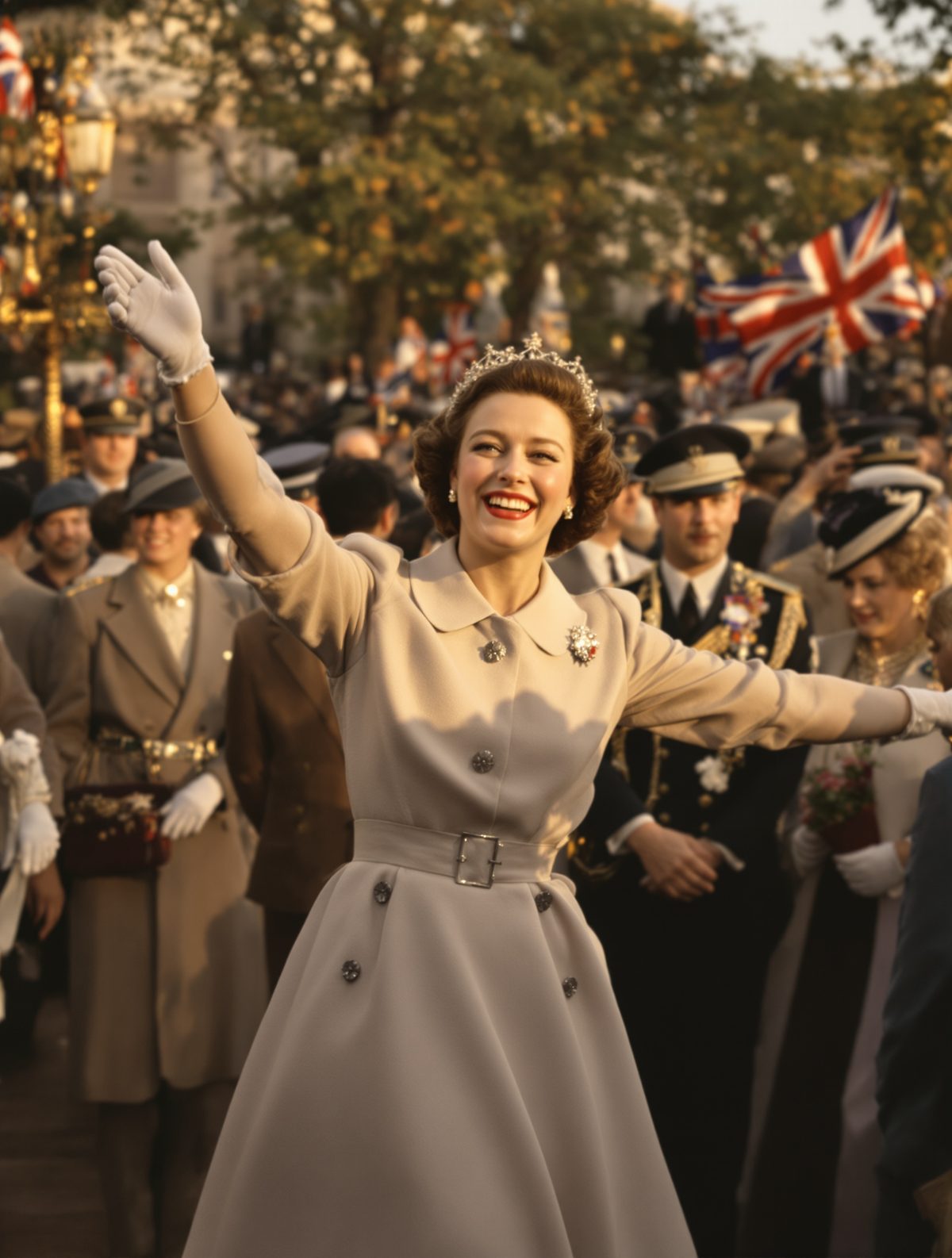
Slipping out through the palace gates, the group immediately found themselves swept up in the extraordinary atmosphere that had transformed London. The usually reserved British public had abandoned all restraint, dancing in the streets, linking arms with complete strangers, and celebrating with an uninhibited joy that many witnesses described as almost magical. For Elizabeth, accustomed to the formal interactions of royal life, this immersion in spontaneous public celebration was a revelation.
Dancing with Strangers: A Future Queen Among Her People
What made the evening truly remarkable was how completely anonymous Elizabeth remained throughout the night. Despite being one of the most recognisable faces in Britain, the combination of darkness, the chaos of celebration, and perhaps the sheer impossibility of imagining the Princess in such circumstances meant that her fellow revellers had no idea of their companion's true identity. She danced conga lines down the Mall, linked arms with strangers, and experienced the pure, unguarded joy of a nation celebrating peace.
The night took on an almost fairy-tale quality as the small royal party moved through the celebrating crowds. They joined the throngs calling for the King and Queen to appear on the balcony—with Elizabeth herself shouting for her own parents. The irony was delicious: the heir to the throne standing among her future subjects, all of them united in calling for the very family she would soon rejoin behind the palace walls.
Contemporary accounts suggest that Elizabeth threw herself into the celebrations with genuine enthusiasm, her usual composure replaced by the infectious excitement of the moment. For a young woman who had spent the war years learning about duty, sacrifice, and the weight of future responsibility, this taste of anonymous freedom must have been extraordinarily precious. She was experiencing what her future subjects were feeling, not as their Princess, but as one of them.
A Night to Remember: The Human Side of Royalty
The evening continued well into the night, with the group moving between different celebrations across central London. They experienced the impromptu parties that had sprung up in parks and squares, the singing that echoed from every pub and street corner, and the overwhelming sense of relief and joy that characterised this historic moment. For Elizabeth, it was an education in the spirit and resilience of the British people that no amount of formal briefings could have provided.
The adventure finally ended in the early hours of the morning, when the group made their way back to Buckingham Palace. Elizabeth later described the experience as one of the most memorable nights of her life, a sentiment that speaks to both the extraordinariness of the evening and perhaps to the rarity of such spontaneous experiences in her highly structured existence. The contrast between her official life and this brief taste of anonymity must have been striking and perhaps bittersweet.
What emerges from accounts of that night is not just the story of a daring royal adventure, but a glimpse into the character of the young woman who would become Britain's longest-serving monarch. Elizabeth's desire to share in her people's joy, her ability to blend seamlessly into the crowd, and her genuine enthusiasm for the celebrations revealed qualities that would serve her well throughout her reign: curiosity about her subjects' lives, an understanding of the importance of shared national moments, and a fundamental warmth that protocols and formalities could never quite conceal.
A Defining Moment in Royal History
The VE Day escape stands as one of the most humanising stories in modern royal history, offering a rare glimpse of the future Queen as a young woman experiencing a moment of complete freedom. In a life that would be defined by duty, service, and the weight of the crown, this single night represented something precious and unrepeatable: the chance to be simply herself among her people.
The story has taken on an almost mythical quality over the decades, representing not just a charming royal anecdote but a symbol of the connection between the monarchy and the nation at one of Britain's greatest moments. It speaks to the extraordinary circumstances of the time, when normal rules were suspended and even a future Queen could slip away to dance with strangers in the street.
Today, in an age of heightened security and constant media attention, such spontaneous royal adventures would be impossible. The VE Day escape represents a different era of royal life, when such magical moments of connection could still occur. It reminds us that behind the crown and the ceremony, the House of Windsor has always been a family of individuals with their own dreams, desires, and need for human connection—and that sometimes, even future Queens need to dance in the streets with perfect strangers to truly understand the hearts of the people they will serve.