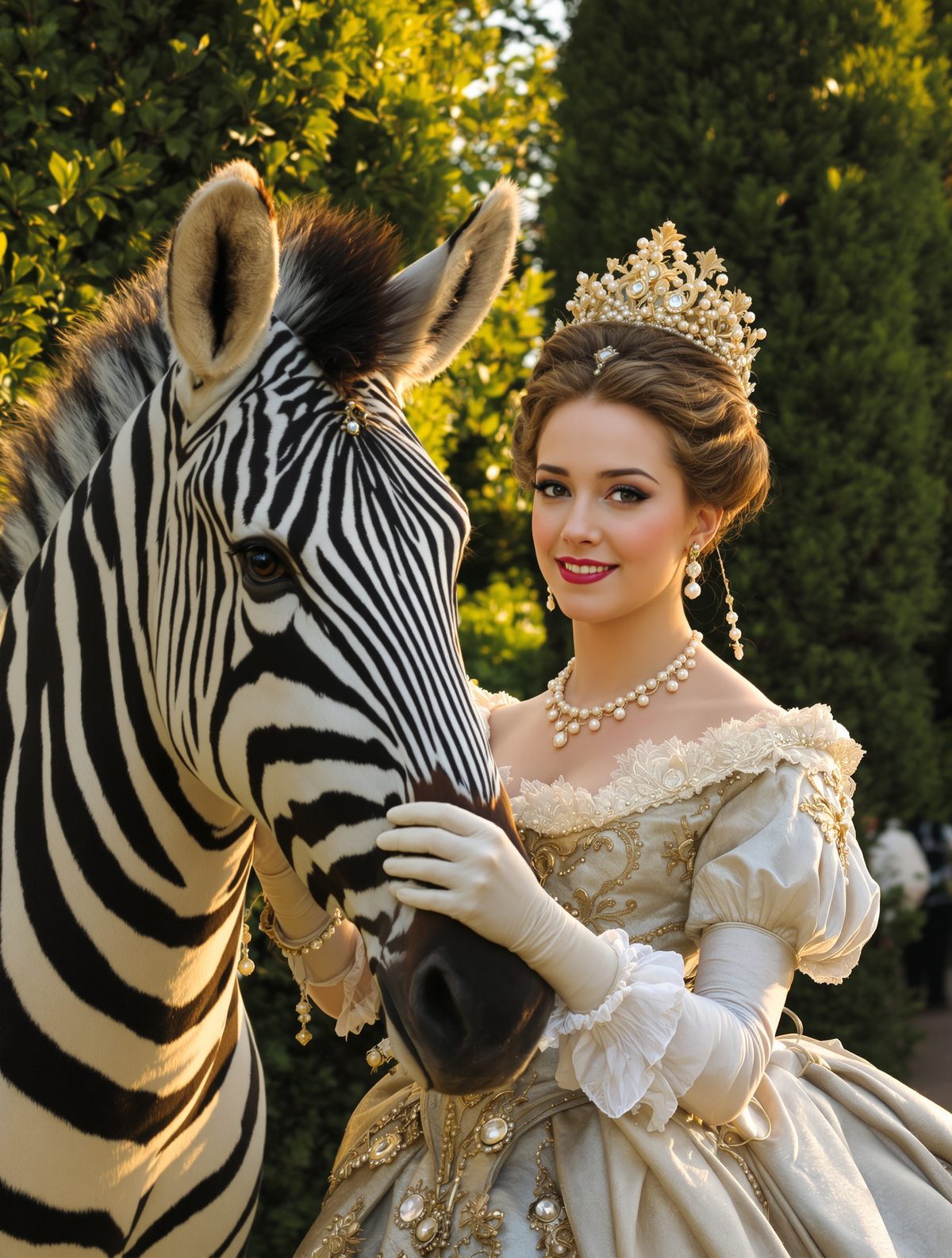
In the balmy summer of 1762, something truly extraordinary occurred on the bustling docks of the River Thames: a sight so rare, so unimaginable, that it would soon capture the attention of the entire city. As the crew of an East Indiaman ship unloaded its precious cargo, tucked among the exotic silks and fragrant spices, emerged a creature that seemed plucked from myth itself — a zebra. Presented as a gift to Queen Charlotte, it was to become an unexpected muse for artists, a curiosity for commoners, and the pride of the burgeoning British Empire. The arrival of this "she-ass from the Cape" spurred a frenzy in Georgian London, forever marking its place in the colorful tapestry of royal history.
The Gift Fit for a Queen
When Charlotte of Mecklenburg-Strelitz married King George III in 1761, she may not have anticipated that one of her first gifts as Queen of Great Britain would challenge the very boundaries of traditional pet ownership. This zebra, bestowed upon her by Sir Thomas Adams, an English merchant, had journeyed from the Dutch colony at the Cape of Good Hope — a testament to the far-reaching corners of British influence.
The Queen, known for her intellectual pursuits and love of nature, was reportedly delighted with this exotic addition to her menagerie. At the time, Buckingham House — what we now know as Buckingham Palace — was her private retreat, and the zebra soon made its home in the lush gardens there. It wasn’t long before Londoners, driven by a blend of curiosity and amazement, flocked to catch a glimpse of this striped wonder.
A Sensational Stir in Georgian London
Word of the Queen's zebra spread quickly, igniting the imagination of a city already alive with the buzz of burgeoning commerce and culture. For many Londoners, this was likely the first exotic animal they had ever seen, and such a spectacle was bound to draw a crowd. Advertisements in newspapers beckoned the public to Buckingham House, and the streets filled with eager spectators, all hoping to witness what seemed to be nature's whimsy painted in black and white.
Queues snaked through the cobbled streets, as visitors patiently awaited their turn. Contemporary records point to the sheer joy and fascination this creature inspired, transcending social classes. What for the upper echelons was a symbol of empire's reach, for the common folk, it was an encounter with the marvels of the wider world.
Royal Influence in the World of Art
Artists of the era, always on the lookout for new muses, were no exception to the zebra's allure. The creature's unique appearance undoubtedly presented both a challenge and an opportunity. It’s said that painters scrambled to capture its likeness, their brushes poised to translate this living curiosity into timeless art. Among them, the renowned animal painter George Stubbs was inspired, his skilled hand immortalizing the creature within the annals of equine portraiture.
In many ways, the zebra represented the zeitgeist of the Georgian era — a period marked by exploration, discovery, and an insatiable appetite for the novel. As brush met canvas, the zebra transcended its earthly form, becoming a symbol not only of imperial reach but of human curiosity itself.
The Zebra's Cultural Legacy
The impact of Queen Charlotte's zebra expanded beyond its physical presence among royal gardens. It sparked something deeper within the Georgian psyche — a thirst for knowledge about the natural world and other "exotica" that lay beyond British shores. Rumors of the zebra’s distinct character traits and behavior ignited whimsies of imagination, weaving tales that would be shared for generations.
Furthermore, the zebra's introduction to London society provided insight into royal life — a glimpse of how monarchic customs evolved with the wave of global exploration and colonial exchanges. Queen Charlotte’s openness to such a gift, her nurturing curiosity, and her decision to share the animal with the public highlight the human stories amid royalty, where punctuations of wonder could be found amidst the demands of governance.
A Royal Inspiration for Today
Today, Queen Charlotte's zebra reminds us of a lost time where the intersection of the natural world and human society was filled with awe and possibility. It serves as a poignant reminder of the monarchical tradition's power to connect us with the marvels of our world. Centuries later, as we continue our own explorations — whether in the fields of science, culture, or technology — we echo the same curiosity that once brought a zebra onto the docks of the Thames.
While we no longer need ships from faraway lands to experience the world's riches, the story of Queen Charlotte's zebra invites us to value and pursue wonder in our lives. The British monarchy, with its storied past and living traditions, continues to inspire and connect us to a history steeped in discovery and imagination. As we reflect on this quaint yet captivating chapter, we draw ever closer to the essence of what it means to be part of a richly woven human narrative, where curiosity reigns supreme.