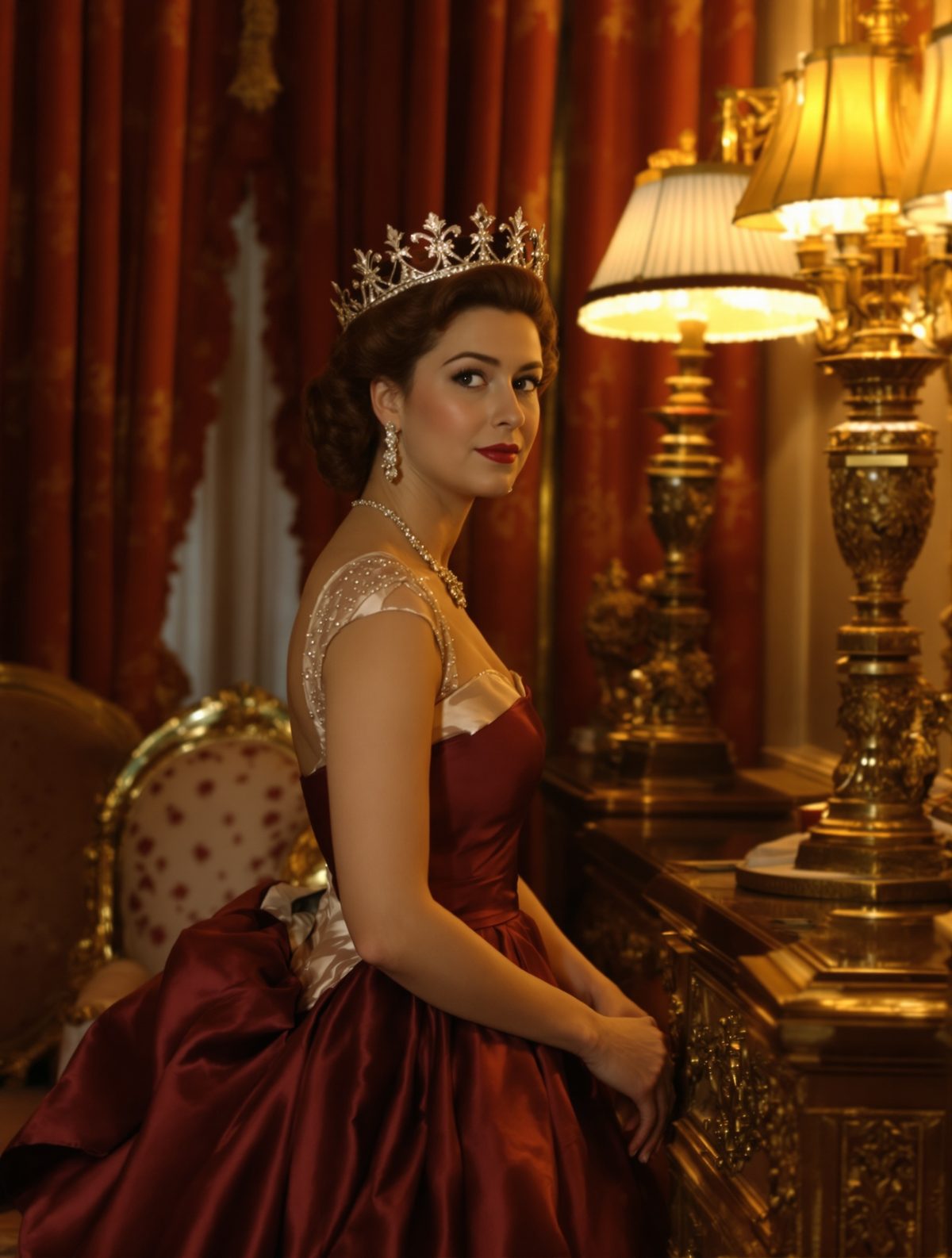
The evening before the most important ceremony of her life, a young Princess Elizabeth was spotted doing something extraordinary in her private chambers. What she practiced with that night would determine the success of her coronation morning. As the clock ticked toward June 2nd, 1953, the soon-to-be Queen walked the length of her room with perfect posture, her head held high and steady—balancing nothing more than a folded sheet of newspaper where tomorrow the ancient St. Edward's Crown would rest.
The Weight of History on Her Shoulders
At just 27 years old, Princess Elizabeth faced a challenge that would have daunted monarchs twice her age. The St. Edward's Crown, crafted for the coronation of Charles II in 1661, weighed a formidable five pounds—equivalent to carrying a large bag of sugar atop one's head for hours. But this wasn't merely about physical endurance; it was about appearing serene, dignified, and utterly composed while bearing the literal weight of a thousand years of British monarchy.
The Princess had already been thrust into her role as heir presumptive following her uncle's abdication and her father's unexpected reign. King George VI's sudden death in February 1952 had accelerated her journey to the throne, leaving her just over a year to prepare for the most elaborate coronation ceremony of the 20th century. Every detail mattered, from the precise timing of each procession to the graceful bearing that would be broadcast live to millions around the world—the first coronation ever to be televised.
Her lady-in-waiting, who witnessed this touching scene of preparation, understood the profound significance of what she was observing. Here was a young woman, barely older than many university graduates today, rehearsing not for an exam or job interview, but for a sacred ceremony that would transform her into the constitutional head of state for sixteen nations and the symbolic leader of the Commonwealth.
The Art of Royal Rehearsal
The newspaper practice session reveals something wonderfully human about the future Queen's approach to her most solemn duty. Rather than relying solely on the formal rehearsals at Westminster Abbey, she took personal responsibility for mastering every aspect of her performance. This wasn't vanity—it was profound dedication to duty and an understanding that millions would be watching her every movement.
The choice of newspaper as a practice prop was both practical and endearing. Unlike the priceless St. Edward's Crown, encrusted with semi-precious stones and steeped in centuries of royal history, a folded newspaper could be safely balanced, dropped, and repositioned without causing an international incident. Yet it served its purpose perfectly, training the Princess's neck muscles and helping her develop the unconscious poise that would be essential during the three-hour ceremony.
This private moment also highlights the meticulous preparation that goes into every major royal occasion. Behind the seemingly effortless grace that the Royal Family displays in public lies hours of careful practice and planning. The young Princess Elizabeth understood instinctively that her coronation would set the tone for her entire reign—she needed to embody the dignity and stability that the British people expected from their sovereign, especially in the post-war years when the nation was rebuilding both its physical infrastructure and its sense of identity.
A Crown's Sacred Significance
The St. Edward's Crown that the Princess was preparing to wear carries extraordinary historical weight beyond its physical heaviness. Named after Edward the Confessor, the last Anglo-Saxon king before the Norman Conquest, it represents an unbroken line of sovereignty stretching back nearly a millennium. The original medieval crown was melted down during the Commonwealth period, but the current version, created for Charles II's restoration, maintains the same symbolic power and sacred significance.
Made of solid gold and standing over a foot tall, the crown features four crosses pattée alternating with four fleur-de-lis, topped with a purple velvet cap and ermine band. Its weight comes not just from the precious metals, but from the symbolic burden of constitutional monarchy itself. When Archbishop Geoffrey Fisher placed it upon Elizabeth's head in Westminster Abbey, she would be accepting responsibility for the welfare of her subjects and the preservation of parliamentary democracy.
The young Princess's newspaper rehearsal demonstrates her deep understanding of this symbolism. She knew that wearing the crown wasn't simply about enduring its weight, but about carrying it with such natural grace that it appeared to belong there—as if she had been born to wear it, which, in many ways, she had.
The Human Touch Behind Royal Splendour
What makes this story so endearing is how it captures the essential humanity behind royal ceremony. Here was the future Queen, in her private chambers, doing something that millions of children might do while playing dress-up—balancing objects on her head to practice walking gracefully. Yet the stakes couldn't have been higher, and her commitment to getting every detail right reveals the character that would define her seven-decade reign.
The presence of her lady-in-waiting as a witness adds another layer of intimacy to the scene. These trusted companions, often friends from childhood, provided not just practical assistance but emotional support during the most challenging moments of royal life. They were the ones who saw behind the public facade, who understood the personal sacrifices required by duty, and who helped maintain some semblance of normalcy in an utterly extraordinary life.
This moment of preparation also speaks to the Princess's perfectionist nature and her genuine respect for the institution she was about to embody. She could have relied on protocol officers and ceremonial experts to guide her through the coronation, but instead she took personal ownership of her performance. This attention to detail and commitment to excellence would become hallmarks of her reign, evident in everything from state visits to Christmas broadcasts.
A Legacy of Grace Under Pressure
The newspaper practice session proved its worth on coronation day itself. Despite the immense pressure, the weight of the crown, and the eyes of the world upon her, the newly crowned Queen Elizabeth II moved through the ceremony with flawless poise. Her steady bearing and natural dignity transformed what could have been an ordeal into a moment of transcendent beauty that inspired confidence in the monarchy's future.
Looking back across the decades of her remarkable reign, that image of the young Princess practicing with a newspaper seems almost prophetic. It captures perfectly the blend of duty and humility, preparation and natural grace, that would characterize her approach to royal service. She understood from the very beginning that being Queen wasn't about the crown itself, but about how one wore it—not just physically, but in every aspect of public and private life.
Today, as we witness a new generation of royals preparing for their own moments of destiny, there's something profoundly moving about remembering that even the most seemingly effortless royal performances begin with simple, human moments of practice and preparation. The young woman balancing a newspaper on her head in 1953 would go on to become the longest-reigning British monarch in history, but she never forgot the importance of getting the fundamentals right—one careful step at a time.