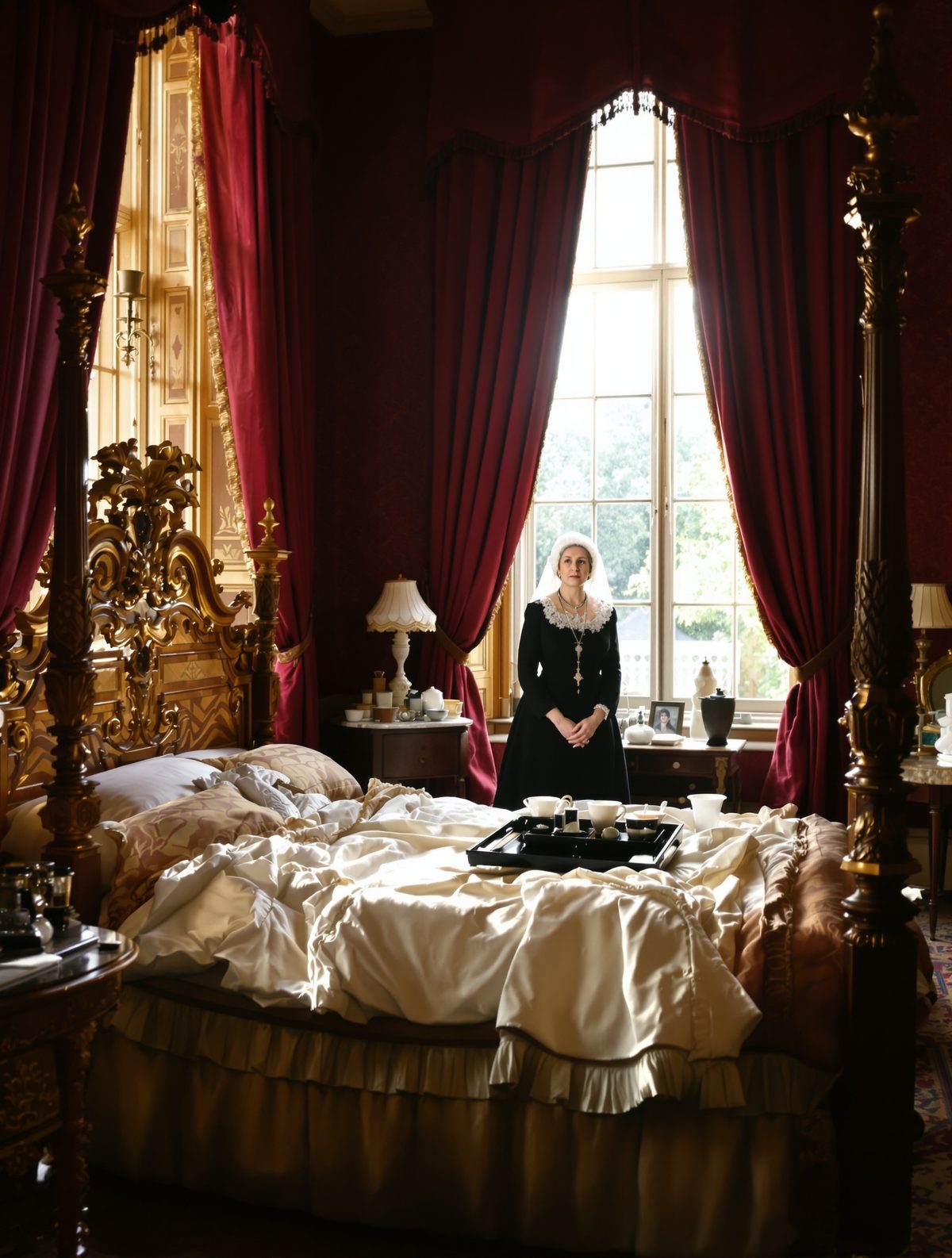
In the hallowed corridors of Windsor Castle, where centuries of royal history echo through stone walls, one room remained frozen in time for forty years. Every dawn brought the same ritual: servants would enter Prince Albert's quarters, draw back the heavy curtains, and begin their extraordinary daily preparation. Fresh clothes were laid out with military precision. Hot shaving water steamed in ornate basins. Breakfast was served on finest china. Yet the bed would never be disturbed, the clothes never worn, the meal never touched. This was Queen Victoria's most private grief made manifest—a daily act of love that would define the final four decades of her remarkable reign.
A Love Beyond Death
When Prince Albert succumbed to typhoid fever on 14 December 1861, at just 42 years old, Queen Victoria's world shattered completely. Their marriage had been far more than a political alliance; it was a genuine love match that had produced nine children and transformed the British monarchy. Albert had been her closest advisor, her intellectual equal, and her emotional anchor. In her own words, he was "the light of my life."
The depth of Victoria's devastation became apparent within hours of Albert's death. She immediately ordered that his rooms at Windsor Castle—and indeed at all their residences—be maintained exactly as he had left them. This wasn't merely about preserving his memory; it was about keeping him present in her daily life. The Queen's instructions were precise and non-negotiable: Albert's personal effects must remain untouched, his belongings kept in their exact positions, and his daily routine honored as if he might return at any moment.
What followed was perhaps the most elaborate memorial ritual in royal history. Each morning, Victoria's most trusted servants would begin their solemn duties in the Blue Room at Windsor Castle, where Albert had breathed his last. Fresh linen was placed on his bed, his nightclothes carefully arranged. In his dressing room, a complete change of clothes was laid out—from undergarments to evening wear—pressed and ready. Hot water was brought for shaving, towels warmed and precisely folded. Even his writing desk was prepared with fresh ink and paper, as if urgent state business awaited his attention.
The Sacred Breakfast Ritual
Perhaps the most poignant element of this daily observance was the breakfast service. Every morning for forty years, Albert's meal was prepared according to his exact preferences and served on his personal china in his private dining room. The toast was cut just as he liked it, the coffee prepared to his precise taste, the newspapers of the day laid out beside his place setting. This wasn't mere ceremony—Victoria insisted on the highest standards, as if Albert himself would critique the service.
The Queen's personal servants, initially bewildered by these requests, soon understood the profound love behind them. Many reported being moved to tears as they carried out these duties, recognizing that they were participating in something far beyond royal eccentricity. They were witnessing a monarch's attempt to maintain connection with her beloved husband across the divide of death.
Victoria herself would often visit Albert's rooms during these morning preparations. She would sit quietly in his favorite chair, sometimes touching his belongings or reading from his correspondence. According to her private journals, she found these moments both heartbreaking and comforting—a way to feel his presence in her increasingly lonely world.
A Court in Perpetual Mourning
The preservation of Albert's rooms was only one aspect of how grief transformed the British royal court. Victoria's extended mourning period—she wore black for the remainder of her life—was accompanied by strict protocols that affected everyone around her. The palace atmosphere became notably subdued, with entertainment severely curtailed and social gatherings dramatically reduced.
Yet the daily ritual in Albert's chambers provided structure to Victoria's grief-stricken existence. Palace staff noted that the Queen seemed to draw strength from knowing that somewhere in her residence, Albert's day was beginning as it always had. His clothes awaited him, his breakfast was served, his papers prepared. In maintaining his physical world, Victoria was preserving the essence of their partnership.
The ritual extended beyond Windsor Castle. At Balmoral, their beloved Scottish retreat, Albert's rooms received the same meticulous attention. His hunting clothes were brushed and ready, his walking sticks polished, his study arranged for work. Even at Osborne House on the Isle of Wight, where they had shared some of their happiest family moments, the daily preparation continued without fail.
Servants' Devotion and Understanding
The remarkable aspect of this four-decade ritual was how completely the royal household embraced it. Initially, some might have questioned the wisdom of encouraging the Queen's grief, but her staff came to understand that these daily observances provided essential comfort. Senior servants passed down the exact requirements to their successors, ensuring that every detail was maintained with religious precision.
John Brown, Victoria's famous Scottish attendant, was particularly devoted to maintaining Albert's memory through these rituals. He understood better than most how the daily preparations helped anchor the Queen's emotional well-being. Other longtime servants spoke of feeling honored to participate in something so deeply personal and meaningful to their sovereign.
The kitchen staff took special pride in preparing Albert's breakfast to perfection, even decades after his death. Housemaids treated his rooms with exceptional reverence, understanding that they were maintaining more than mere chambers—they were preserving a sacred space where love transcended mortality. Even newer servants, who had never known Prince Albert, quickly grasped the profound significance of their duties.
Legacy of Eternal Devotion
Victoria's daily ritual for Albert continued until her own death in 1901, making it one of the longest-maintained memorial observances in royal history. When she finally passed away at Osborne House, among her final wishes was that the tradition should end with her—she would join Albert at last, making earthly preparations unnecessary.
This extraordinary demonstration of marital devotion reveals the deeply human heart beneath Victoria's imperial crown. In an era when royal marriages were typically political arrangements, her genuine love for Albert—and her refusal to let death diminish that love—speaks to something timelessly powerful about human connection and commitment.
Today, as we observe modern royal marriages and partnerships, Victoria's devotion to Albert provides a remarkable precedent for what authentic love looks like in the highest echelons of society. Her morning rituals remind us that beneath the crowns and ceremonies, royal relationships are fundamentally human stories of love, loss, and the eternal hope that love endures beyond our earthly existence. The image of fresh clothes laid out each dawn for a beloved who would never wear them again captures something profound about the nature of true partnership—it continues even when one partner can no longer participate, sustained by memory, ritual, and the unshakeable belief that love transcends even death itself.