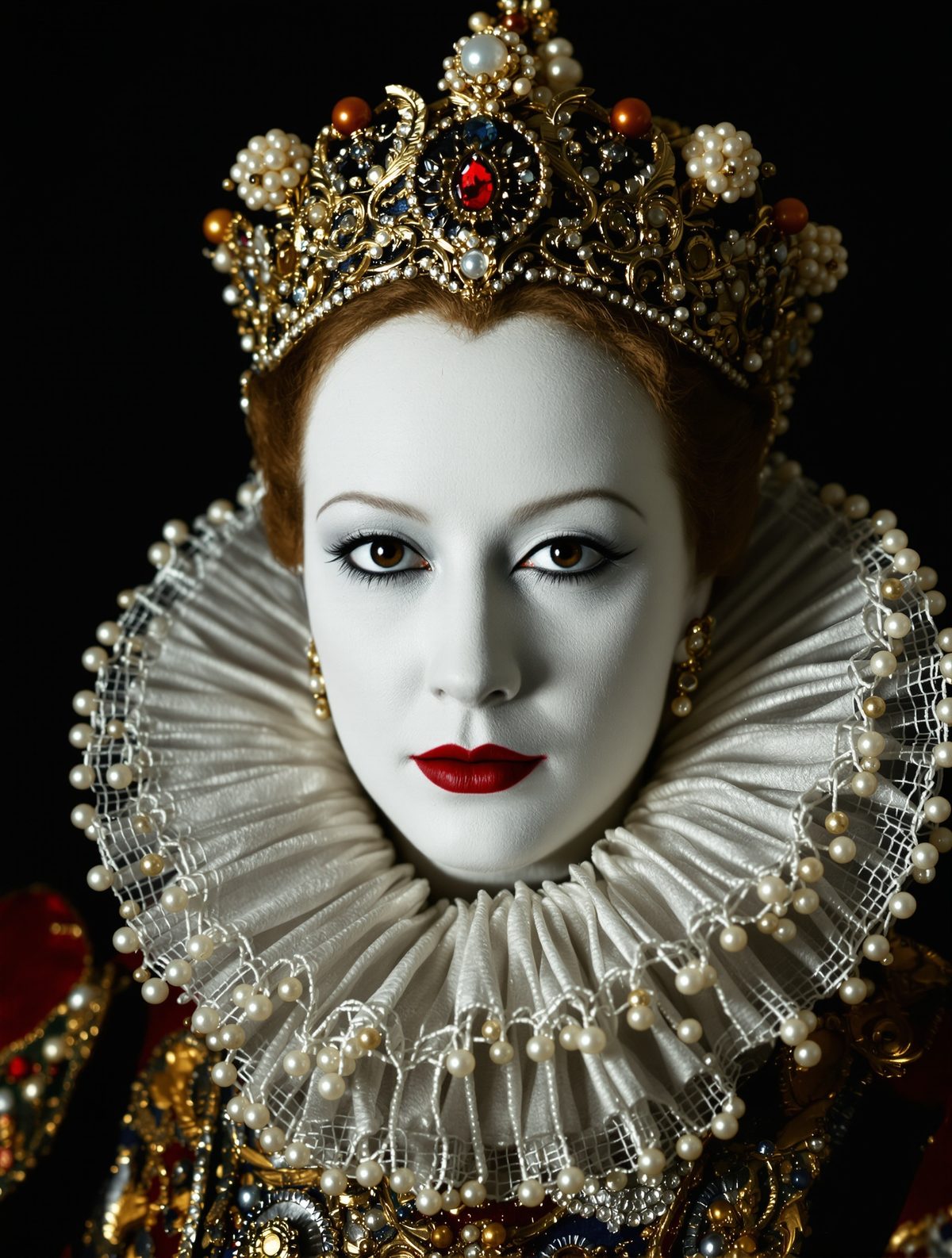
In the glittering court of 16th-century England, where appearance was power and image was everything, Queen Elizabeth I transformed herself into a living goddess through one of history's most dangerous beauty routines. Her ghostly white complexion, painted with mathematical precision and maintained with religious devotion, became the most recognizable royal look ever created. But beneath that luminous porcelain mask lay a deadly secret that would slowly poison the Virgin Queen for decades: her face powder contained crushed pearls and toxic white lead that gradually destroyed her health while cementing her legendary status.
The Art of Royal Transformation
Elizabeth's morning ritual was nothing short of theatrical alchemy. In her private chambers at Whitehall Palace, surrounded by ladies-in-waiting sworn to secrecy, the Queen would undergo a transformation that took hours to complete. The process began with a base of white lead mixed with vinegar, creating a paste that would cover every inch of exposed skin. But Elizabeth demanded something more precious, more fitting for England's sovereign: crushed pearls.
The pearls weren't merely decorative—they served a practical purpose in the Queen's mind. The crushed nacre was believed to add luminosity to the skin, creating an otherworldly glow that would catch candlelight and make her appear almost supernatural to her subjects. Court records from the 1580s show regular purchases of pearls specifically for "Her Majesty's complexion," with some entries noting pearls worth hundreds of pounds in today's currency being ground to powder.
This wasn't vanity—it was statecraft. Every morning, Elizabeth literally painted on her authority, transforming from mortal woman to divine ruler. The white lead gave her the pallor of marble statuary, while the pearl dust created an iridescent quality that made her seem to glow from within. Courtiers described her as appearing "carved from moonlight" and "touched by celestial radiance."
Fashion as Political Warfare
Elizabeth's stark white complexion wasn't born in a vacuum—it was a calculated response to the beauty standards and political pressures of her age. In an era when a woman's power was often questioned, the Queen used her appearance as armor, creating a look so distinctive and commanding that it became inseparable from royal authority itself.
The fashion for pale skin had practical origins among the nobility. A white complexion signified that one didn't labor outdoors, marking clear class distinctions. But Elizabeth elevated this trend to an art form, taking it to extremes that no other royal had dared. While other European queens might powder their faces lightly, Elizabeth created a mask so complete that ambassadors wrote home describing her as looking more like a painted icon than a living woman.
This dramatic look also served to obscure the signs of aging and illness. As Elizabeth entered her fifties in the 1580s, the thick white coating helped maintain the illusion of eternal youth that was so crucial to her political image. The Virgin Queen had to appear timeless, untouchable, and divinely blessed—and her pearl-and-lead complexion helped create exactly that impression.
Her courtiers understood the message: this was not a woman to be trifled with, but a creature apart, ruling by divine right and protected by forces beyond mortal understanding. The white face became as much a part of Elizabeth's royal regalia as her crown or scepter.
The Deadly Price of Perfection
What Elizabeth and her era didn't understand was the horrific toll her beauty routine was taking on her health. White lead, known as ceruse, was essentially lead carbonate—a deadly poison that the Queen applied to her face daily for nearly four decades. Each morning's application added another layer of toxicity that her body would absorb through her skin.
The symptoms of lead poisoning develop slowly, insidiously. By the 1590s, courtiers began noting changes in the Queen's behavior and health that we now recognize as classic signs of chronic lead exposure. She became increasingly irritable and prone to violent mood swings. Her memory, once razor-sharp, began showing troubling gaps. Most tellingly, her hair began falling out—a common result of lead poisoning—forcing her to rely increasingly on elaborate wigs.
The lead didn't just affect Elizabeth's health; it damaged her skin permanently. Contemporary accounts describe her complexion in later years as deeply scarred and pitted, requiring ever-thicker applications of the poisonous paste to achieve the smooth perfection her image demanded. It became a vicious cycle: the more damage the lead caused, the more she needed to hide the destruction it wrought.
Even the precious pearls contributed to the damage. The grinding process often left sharp fragments that would scratch and irritate the skin, creating tiny wounds through which the lead could more easily enter her bloodstream. What began as a symbol of purity and divine favor became an instrument of slow destruction.
The Secret Palace Industry
Creating Elizabeth's signature look required an entire hidden infrastructure within the royal palaces. Specialized servants, sworn to secrecy, were responsible for sourcing and preparing the Queen's cosmetics. The process of grinding pearls to the perfect fineness was an art in itself, requiring skilled craftsmen who understood exactly the texture Elizabeth preferred.
The white lead had to be prepared with equal care. Court records show payments to apothecaries for "the finest ceruse of Venice," indicating that Elizabeth demanded only the highest quality poison for her face. The lead was mixed with various oils and vinegar to create different consistencies for different occasions—lighter applications for daily wear, and theatrical thick coatings for major court events.
This beauty routine was so elaborate that it required constant maintenance throughout the day. Ladies-in-waiting carried special pouches containing pearl powder and additional ceruse to touch up the Queen's complexion between audiences. The mixture would crack and flake, especially around the mouth and eyes, requiring frequent reapplication to maintain the flawless mask.
The secrecy surrounding these preparations was absolute. Elizabeth understood that revealing the artificial nature of her otherworldly appearance would undermine the carefully constructed image of divine favor that was so crucial to her rule. The recipe for her face powder was known only to a handful of trusted servants, and they took their knowledge to their graves.
Legacy of the Painted Queen
The irony of Elizabeth's toxic beauty routine is breathtaking: in her quest to appear eternally youthful and divinely blessed, she slowly poisoned herself with substances that hastened her aging and likely contributed to her death at 69. Yet the image she created proved more enduring than the woman herself. Nearly five centuries later, Elizabeth's ghostly white complexion remains the most recognizable royal look in history.
Her influence on beauty standards extended far beyond her own reign. For generations after her death, English noblewomen continued using white lead cosmetics, despite growing awareness of their dangers. The association between pale skin and aristocratic status that Elizabeth had taken to such extremes continued well into the 18th century.
Modern historians and scientists have been able to piece together the full extent of Elizabeth's cosmetic arsenal through analysis of surviving portraits and court records. What emerges is a picture of extraordinary dedication to image-making, even at the cost of personal health and comfort. The Virgin Queen literally sacrificed her body to create and maintain the icon that would secure her political survival and historical immortality.
Today, as we watch modern royals navigate the pressures of public scrutiny and image management, Elizabeth's story serves as a powerful reminder of the lengths to which rulers have always gone to craft their public personas. While contemporary royals may face the constant gaze of cameras and social media, none have paid quite so steep a price for their iconic looks as the first Elizabeth, who painted herself into legend one toxic layer at a time.